Showing posts with label Zoning. Show all posts

Wednesday, June 22, 2011

U of C Public Planning/Zoning Meeting Tonight

posted by Elizabeth Fama

This evening the U of C is holding a public meeting at the International House, 1414 East 59th Street, at 6 PM.

From a U of C official:

The University as a whole is in a planned development zone, and is working with the city right now to update the zone. As part of that process there will be public hearings. Some of the issues that come up have to do with height of buildings, what is in the zone (the University has acquired property since the zone was last formed), etc. The city has requirements for which neighbors should be notified about any planned changes — essentially all residents within 250 feet of the zone perimeter. That group received a letter. In addition, we have done some stories about this to be sure it is much more public.
 

Tuesday, February 24, 2009

Report from Del Prado Zoning Meeting


posted by Richard Gill


Return to Glory for
"The Finest Residential and Transient Hotel in the Middle West"?

There was a public meeting Monday evening (Feb. 23) to seek comments on MAC's request to change the zoning of the Del Prado, which MAC is rehabbing. The requested change is from B1-5 to B3-5 (the same change that was sought and approved for MAC's building on 55th Street, west of Cornell).

The change would allow restaurants in the building to serve liquor and to have a bar area, provided a restaurant applies for, and obtains, a liquor license.

The new zoning would not permit liquor stores or taverns unless special zoning revisions were to be approved through public process, aldermanic review and city council approval. It was agreed that such changes, while possible, are extremely unlikely to be approved. Ald. Hairston noted further that liquor licenses can be, and have been, revoked.

Some attendees expressed reservations about the change, but in general, the B3-5 rezoning was greeted favorably. My statement was that I believe the potential benefits greatly outweigh the risks.

Alderman Hairston and Peter Cassel of MAC hosted the meeting. Peter stated that the Del Prado is a landmarked building with grand ballrooms and public spaces inside, and that these will not be adequately utilized nor will they attract operators unless liquor can be served. He said MAC's hope is to have the Del Prado work in connection with other nearby buildings, to present an attractive 53rd Street gateway to Hyde Park, for people coming off Lake Shore Drive at the 53rd Street exit. He said this requires that the buildings be commercially attractive and viable.

Sunday, October 5, 2008

MAC Request for 55th St. Zoning Change

posted by Richard Gill

Roughly 20 people attended Alderman Hairston's informal community meeting on Thursday, October 2, at 1621 E. 55th Street. The purpose of the meeting was to explain a request to re-zone the building on the south side of 55th Street between Cornell and the railroad embankment, and to let local residents express their opinions.

MAC Realty, the building's owner, is the requesting party and is acting on behalf of restaurant owners in the building, who initiated the request. The present zoning, B.1-5 would be changed to B.3-5. The change would allow the restaurants to apply for liquor licenses; if the licenses are granted, the restaurants could serve alcoholic beverages along with meals. In theory, the change would also allow the building to house a tavern, but that would require a further special approval process.

Under the revised zoning, veterinarians would be allowed to operate on the property. I found this interesting (although not necessarily indicative of future activity), in light of recent news coverage of Dr. Wake's need to relocate his veterinary clinic out of Harper Court.

Peter Cassell, of MAC, and the Alderman presented the zoning request as a step toward enhancing the retail options in Hyde Park, by helping to improve the business climate. The attendees at the meeting seemed generally in favor of the change, and Cassell said a number of the building's apartment residents were in favor.

One resident, however, worried aloud that there would be noisy drunks staggering out of the restaurants at all hours. Oh, c'mon. In response, it was noted that the restaurants presently allow diners free BYOB privileges, so drinking already takes place on the premises and no problems have been reported. Further, a restaurant can limit the amount of alcohol sold to and subsequently consumed by individuals; limiting consumption under BYOB is much harder.

Someone else said the change would exacerbate the "parking problem," and the meeting then lapsed into the classic Hyde Park "parking problem discussion." C'mon again. Those restaurants are largely patronized by people who arrive on foot, and anyway there is no reason to expect that more people will drive just because they can have a cold beer with their meal.

After a while, the Alderman simply laid it out (yet one more time): She said we live in a crowded city, and there are more cars than will fit at the curb. She said that all the studies and committees are not going to change that fact. She said further that there is no place in the neighborhood to build large-capacity off-street parking, and experience has shown that people don't want to pay to use it. My (uncharacteristically caustic?) comment to the group was, "Free parking is not a God-given right."

Hairston then returned to the zoning question and said, in effect, "Look, folks, everyone complains about having to leave the neighborhood in order to spend their money. This proposal is a way to change some of that."

I'm glad Hairston came on strong on the parking and zoning issues.

The process will probably take a few months;there has to be a formal application, notice to people living within 250 feet of the property, consideration by the city zoning committee, approval by the full city council. Then the proprietors have to obtain liquor licenses (which can be revoked in the event of abuse or inappropriate customer behavior).

This, by the way, is strictly a zoning request; it has nothing to do with wet/dry precincts under "local option."

That's the essential content of the meeting, which lasted an hour and 20 minutes. One more interesting tidbit did come out: Under both present and proposed zoning, the building could be up to 100 feet high; it isn't even half that tall.

Monday, September 29, 2008

Wicker Park's NIMBY Envy

posted by chicago pop

The other day a copy of the West Town Chicago Journal: News of Bucktown, Wicker Park, Ukrainian Village fell in my lap.

Imagine my surprise when I beheld the following elements:

Headline: "Hotel Opposed for Now"

Front Page Human Interest Story: Crystal Fencke, Contributing Reporter

Editorial: "Show Hotel Project Plans. Lack of Communication Shows Lack of Respect."

So when did the Herald go into syndication? It's got a hotel. It's got opposition to the hotel. It's got an editorial channelling Pat Dowell channelling Aretha Franklin ("Respect"). It's even got an article by Herald contributor Crystal Fencke.

Do you think the folks in Wicker Park could come up with their own neighborhood controversies?

You can check out the skinny here:

A developer planning to convert the Northwest Tower [pictured above] into a hotel has filed for a special permit needed to go forward with the project, leaving the area's alderman, the city's planning department and community organizations that typically vet such projects in the dark.

Thirty-second Ward Alderman Scott Waguespack said he likes the idea of establishing a hotel in the 77-foot tower at North and Milwaukee, but he does not have enough information to support the application for a special use permit that MCM, the building's owner, has requested from the Zoning Board of Appeals.

Waguespack said his office did not know the ZBA would consider such a request from MCM until neighbors to the proposed project, who spotted signs announcing the permit application in the tower's windows, notified him. MCM did not present its plans to area community groups, he said.

"We said, until you come up with a development plan we're not going to move forward on it," Waugespack said. "You can't just throw up a hotel."


And this has got to be a move taken from the Hyde Park playbook:

Waguespack said he wants MCM to complete a traffic study for the site and a feasibility study that would demonstrate the need for a hotel in the area...[he] also wants to know who the potential operators of the hotel are.

All in all, this seems like a pale imitation of the Doctors Hospital controversy. It's just a clumsy developer, it's not the Borg Collective otherwise known as the University of Chicago. Alderman Waguespack likes the idea of a hotel, is setting out some guidelines in advance (even calling for a traffic study before the NIMBYs do!) and the Northwest Tower, unlike the old Doctors Hospital, is clearly a building worth preserving.

These folks actually seem to want development at this location, even if the current candidate seems to be a bit obtuse on the PR front.

Still, the facts are these: there is no permit, there is no hotel operator, there is just an intention.

The question here seems to be, unlike the Doctors Hospital case, what is the proper process? Do you go to community groups before you have a project lined up (operator, permit process underway), when nothing may really come of it, or do you go to them after you have at least gotten the process moving with some probability of being able to execute?

At this point, Wicker Park's hotel controversy seems to be much ado about nothing. If real plans are drawn up, with a permit to act on them, and the community groups are called in, then we'll see how it plays out, and whether it's worthy of comparison with our own Doctors Hospital.


Wednesday, September 17, 2008

What the Tribune's Zoning Series Missed

posted by chicago pop

Short answer: Half the story.

Longer answer: The Chicago Tribune's zoning series missed the half of the story that corresponds to the half of the city known as the South Side.

To understand how this is so, all you have to do is to compare two photographs from different sections of the same newspaper, the Chicago Tribune.

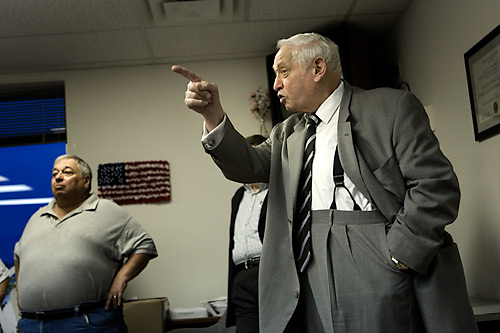
The first photo, below, is taken from the last in a 5-piece investigation by the Tribune into zoning, development, and corruption, "Neighborhoods for Sale", which ran from January to August of 2008.

2008-09-15-BernardStoneDevelopmentMeetingPhotobyAlexGarcia.jpg

Berny Stone: If You Don't Like My Plan The Guy to My Right Will Sit on You
(Source: Chicago Tribune. Photo by Alex Garcia)


Here we see Alderman Bernard Stone (50th) defending the proposed development of a retirement home in his community at a testy meeting with constituents who, according to interviews given to the Trib, largely oppose the plan. Why? Because an old-folks home, full of people in wheelchairs who don't drive to work, will supposedly cause traffic congestion.

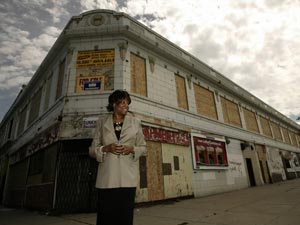
Compare this snapshot of an alderman at work in the illustration below, from an article that ran in the Tribune's business section last week (September 12, 2008).

2008-09-15-PatDowellWashingtonParkPhotobyTerrenceAntonioJames.jpg

Pat Dowell's Buffalo Park: There's Just More Room on the Sidewalks Down Here
(Source: Chicago Tribune. Photo by Terrence Antonio James)


Here we see a handsome photo of 3rd Ward Alderman Pat Dowell posing before a vacant commercial building. If you didn't already know the story, you could be forgiven for thinking that maybe this person hopes to be the next Jerry Kleiner, that the article is from the Food section, and that the dump behind her is on its way to becoming the next Red Light.

Not so. Dowell has no plans other than glamor photo shoots for the fire hazard behind her. Someone else does, however, and this makes her mad. She wants to protect her ward's inventory of empty buildings from people who might tear them down and build something that would attract tenants, customers, and tax revenue.

These pictures represent two different realities. Neither of them alone does justice to the equally insane but distinctly different dynamics of neighborhood development in Chicago. This diversity is clear to readers who leaf through the various sections of the Tribune , but it's a point that is lost in the tight muckraking focus of the "Neighborhoods for Sale" series.

The argument of "Neighborhoods for Sale" is not surprising. It's such a familiar story, in fact, that I feel like it could have been written before any of the research was done. Chicago aldermen, the argument goes, are in the pockets of real estate developers, who run rampant over the city's meaningless zoning code and run circles around the ineffectual wonks in its Department of Planning. In no other American city do planning and development work like this.

The results, which we are all familiar with, are the conspicuously over-sized, architecturally out-of-context, and often poorly constructed residential monstrosities that have come to symbolize the go-go years of the 1990s on the city's North Side. Plus fat-cat developers and corrupt aldermen.

All very well.

But if you think this series will help you understand how things work on the Near South Side, you're wrong. Or maybe it will, if you turn it upside down and hold it in a mirror. Community groups in the Near South Side shoo away developers, and aldermen run scared of community groups that have spent 40 years perfecting the techniques of obstruction. When they're not posing proudly in front of empty buildings.

Take the situation in Hyde Park, Barack Obama's home, and my neighborhood.

Community groups -- the kind that the "Neighborhoods For Sale" authors argue are typically kept out of ward-level decision-making -- killed a painfully negotiated compromise plan for Federally-funded renovation of the shoreline around Promontory Point in 2005. They spooked Alderman Leslie Hairston (5th) into blocking demolition of an empty hospital to make way for a Marriott in 2007, and are prepared to vote the precinct dry to block it again in 2008.

A handful of neighbors scared a developer away from replacing a derelict church that has been empty and falling apart since at least 1999; and yet another small group of people leaned into Alderman Toni Preckwinkle when she made it known that she favored a mixed-use residential project on a stretch of 53rd Street, presently home to a vacant lot and a car wash.

And Alderman Pat Dowell is offended that a private party, the University of Chicago, wants to horn in on her hoard of vacant lots and empty buildings.

Dowell's 3rd Ward: Forever Open, Clear, and Free

The "Neighborhoods for Sale" series performed a useful service in detailing the abuses to which the current development process is prone in the city of Chicago. It did not issue an authoritative diagnosis of the problem. That would have required looking at those large portions of the city where the issue is not too much development, but too little, and where community input is less the solution, and more of the problem.

[This post also appears at Huffington Post Chicago]