Showing posts with label Community Activism. Show all posts

Sunday, September 20, 2009

Letter From an Old Goat

posted by Richard Gill


In the September 17 Tribune crossword puzzle, the answer to 42 Down is “Old Goat.” The clue is “Nasty geezer,” which pretty well describes me when I read about Hyde Park residents who regard everything in the neighborhood as community property. It makes me want to take my bent spectacles, my crooked cane, and my jug of hard cider over to Medici and snap at passers by.

Here are some examples of what I’m talking about. Remember the dysfunctional clock on the Hyde Park Bank Building? The Bank removed the clock and refinished the wall's surface where it had been attached. And the people said, how dare the evil bankers decide what to do with their own clock on their own building without consulting “the community?”

Then the University of Chicago demolished a vacant building at Harper Court, which it owns. It was known and agreed upon that the building would be demolished. And the Hyde Park Herald said, how dare the evil University begin demolition of its own building without consulting us first.

Now we hear about unhappiness in some quarters that the University repaved an interior driveway deep within the main quadrangle. And the people said, how dare the evil university work on its own infrastructure in a location that is not visible from outside, without getting our permission?

Community relations, civic engagement, good neighboring, or whatever you call it, is a thankless task for businesses and institutions. In Hyde Park, it must be agonizing. Whoever does this work for the Bank, the University, whatever, can’t get paid enough. Every day, they have to deal with Hyde Park, the busybody capital of America. In my opinion, the University of Chicago in particular has been patient to a fault. No wonder they sometimes just go ahead with stuff, as well they should. Otherwise nothing, absolutely nothing would get done.

The University’s board and administrators have a first class school to operate, fund, nurture and protect. Community involvement is one thing, but not the main thing, not by a long shot. In the big picture, it is not necessary for a university to be loved by its neighbors, nor even liked. But at some point, an institution's strident and unreasonable neighbors create a burden and a distraction. If community relations are good, that’s terrific. If not, that’s too bad.

I’m an old goat and a nasty geezer. If I were king of the University of Chicago, I wouldn’t have the patience for this neighborhood’s nonsense. After all, I'd have a great university to run, and I’d tell the neighbors to go to…..to go and fix their own driveways.

Wednesday, August 5, 2009

RIOT FIRST, RESEARCH LATER!

posted by Elizabeth Fama


We have a problem in Hyde Park. Let's call it "un-researched activism (U.A.)." The most painful example is the Point debacle, where hundreds of otherwise level-headed Hyde Parkers earnestly signed their names away and gave money to a deceptive "Save the Point" campaign, without even seeing the Compromise Plan that the City and Park District had offered us.

A small instance of U.A. occurred this week, but it may have slipped under your radar if you're not a University of Chicago Laboratory Schools student, alum, or parent. It's a valuable case study, and unlike the Point debacle, it has a happy ending.

The Lab Schools have three beloved Public Safety Coordinators (security guards). All three go beyond the call of duty, and are indispensable parts of the school community. The U of C Police, in an effort to reduce costs (ordered by President Zimmer across all departments) decided to outsource their security guard duties to a company called Allied Barton, which pays minimum wage. The three guards were offered employment with Allied Barton, but the pay cut was too severe, so they declined.

Begin the rioting: a well-meaning High School student (a sweet kid and family friend, I should add) started a facebook group to support the guards, saying that the U of C had unceremoniously terminated the guards, and that their last day was on August 15th. She implied that the University had deliberately done it over the summer, so that students and parents couldn't protest or say goodbye. When I joined the group (Wed. 7/29), roughly 350 people were already members (today there are 545) and there were many outraged comments. Parents had also started e-mailing each other, promoting the notion that this was a secretive act on the part of the University, and designed to side-step parental involvement.

That same day I e-mailed the principal of the High School, who sent me on to G. Christopher Jones (Director of Business Affairs) and he was happy -- I'd even say grateful -- to discuss the issue. None of the other facebook members (or, I presume from his tone, parents) had contacted him. Mr. Jones wrote that the Lab Schools administration had gone to bat for the guards, and had asked the University to make a special exception; their arguments were that the Lab Schools is a tiny slice of the security pie (for comparison, the Booth School has 20 guards), and that the personal investment and continuity of these guards are important because children are involved. He said the Lab Schools were participating in ongoing negotiations with Allied Barton and the University. He still seemed to have hope. For one thing, the University's new Associate VP of Safety and Security was sympathetic to the cause, in part because he's a Lab Schools parent himself.

The conclusion of these talks -- reached within the span of a week -- is that the guards will remain as U of C Police employees, and nothing about their status will change.

Now, it would have been fine with me if the facebook group and the flurry of e-mails were simply encouraging people to tell the University that they wanted to keep these guards, and at their current salaries. That kind of message is helpful. What disturbs me is that no one apparently called to check facts before going "viral," and that the story degenerated so quickly into the old "Evil Empire" conspiracy model.

I have a theory about why Hyde Parkers are like this. They're intellectual, and they want to be good, concerned citizens. They think activism is the way to do that. But they're busy -- oh, so busy. So they delegate their research to representatives -- that is, to local community activists, or in this case a high schooler -- or they buy into a sound bite.

Why they leap so quickly to the Evil Empire Model (E.E.M.) is beyond me, though. That's another feature of Hyde Park activism that deserves its own post someday.

Monday, September 29, 2008

Wicker Park's NIMBY Envy

posted by chicago pop

The other day a copy of the West Town Chicago Journal: News of Bucktown, Wicker Park, Ukrainian Village fell in my lap.

Imagine my surprise when I beheld the following elements:

Headline: "Hotel Opposed for Now"

Front Page Human Interest Story: Crystal Fencke, Contributing Reporter

Editorial: "Show Hotel Project Plans. Lack of Communication Shows Lack of Respect."

So when did the Herald go into syndication? It's got a hotel. It's got opposition to the hotel. It's got an editorial channelling Pat Dowell channelling Aretha Franklin ("Respect"). It's even got an article by Herald contributor Crystal Fencke.

Do you think the folks in Wicker Park could come up with their own neighborhood controversies?

You can check out the skinny here:

A developer planning to convert the Northwest Tower [pictured above] into a hotel has filed for a special permit needed to go forward with the project, leaving the area's alderman, the city's planning department and community organizations that typically vet such projects in the dark.

Thirty-second Ward Alderman Scott Waguespack said he likes the idea of establishing a hotel in the 77-foot tower at North and Milwaukee, but he does not have enough information to support the application for a special use permit that MCM, the building's owner, has requested from the Zoning Board of Appeals.

Waguespack said his office did not know the ZBA would consider such a request from MCM until neighbors to the proposed project, who spotted signs announcing the permit application in the tower's windows, notified him. MCM did not present its plans to area community groups, he said.

"We said, until you come up with a development plan we're not going to move forward on it," Waugespack said. "You can't just throw up a hotel."


And this has got to be a move taken from the Hyde Park playbook:

Waguespack said he wants MCM to complete a traffic study for the site and a feasibility study that would demonstrate the need for a hotel in the area...[he] also wants to know who the potential operators of the hotel are.

All in all, this seems like a pale imitation of the Doctors Hospital controversy. It's just a clumsy developer, it's not the Borg Collective otherwise known as the University of Chicago. Alderman Waguespack likes the idea of a hotel, is setting out some guidelines in advance (even calling for a traffic study before the NIMBYs do!) and the Northwest Tower, unlike the old Doctors Hospital, is clearly a building worth preserving.

These folks actually seem to want development at this location, even if the current candidate seems to be a bit obtuse on the PR front.

Still, the facts are these: there is no permit, there is no hotel operator, there is just an intention.

The question here seems to be, unlike the Doctors Hospital case, what is the proper process? Do you go to community groups before you have a project lined up (operator, permit process underway), when nothing may really come of it, or do you go to them after you have at least gotten the process moving with some probability of being able to execute?

At this point, Wicker Park's hotel controversy seems to be much ado about nothing. If real plans are drawn up, with a permit to act on them, and the community groups are called in, then we'll see how it plays out, and whether it's worthy of comparison with our own Doctors Hospital.


Wednesday, September 17, 2008

What the Tribune's Zoning Series Missed

posted by chicago pop

Short answer: Half the story.

Longer answer: The Chicago Tribune's zoning series missed the half of the story that corresponds to the half of the city known as the South Side.

To understand how this is so, all you have to do is to compare two photographs from different sections of the same newspaper, the Chicago Tribune.

The first photo, below, is taken from the last in a 5-piece investigation by the Tribune into zoning, development, and corruption, "Neighborhoods for Sale", which ran from January to August of 2008.

2008-09-15-BernardStoneDevelopmentMeetingPhotobyAlexGarcia.jpg

Berny Stone: If You Don't Like My Plan The Guy to My Right Will Sit on You
(Source: Chicago Tribune. Photo by Alex Garcia)


Here we see Alderman Bernard Stone (50th) defending the proposed development of a retirement home in his community at a testy meeting with constituents who, according to interviews given to the Trib, largely oppose the plan. Why? Because an old-folks home, full of people in wheelchairs who don't drive to work, will supposedly cause traffic congestion.

Compare this snapshot of an alderman at work in the illustration below, from an article that ran in the Tribune's business section last week (September 12, 2008).

2008-09-15-PatDowellWashingtonParkPhotobyTerrenceAntonioJames.jpg

Pat Dowell's Buffalo Park: There's Just More Room on the Sidewalks Down Here
(Source: Chicago Tribune. Photo by Terrence Antonio James)


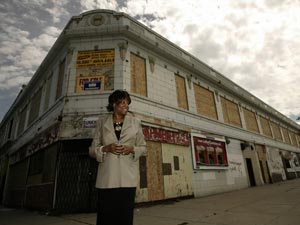
Here we see a handsome photo of 3rd Ward Alderman Pat Dowell posing before a vacant commercial building. If you didn't already know the story, you could be forgiven for thinking that maybe this person hopes to be the next Jerry Kleiner, that the article is from the Food section, and that the dump behind her is on its way to becoming the next Red Light.

Not so. Dowell has no plans other than glamor photo shoots for the fire hazard behind her. Someone else does, however, and this makes her mad. She wants to protect her ward's inventory of empty buildings from people who might tear them down and build something that would attract tenants, customers, and tax revenue.

These pictures represent two different realities. Neither of them alone does justice to the equally insane but distinctly different dynamics of neighborhood development in Chicago. This diversity is clear to readers who leaf through the various sections of the Tribune , but it's a point that is lost in the tight muckraking focus of the "Neighborhoods for Sale" series.

The argument of "Neighborhoods for Sale" is not surprising. It's such a familiar story, in fact, that I feel like it could have been written before any of the research was done. Chicago aldermen, the argument goes, are in the pockets of real estate developers, who run rampant over the city's meaningless zoning code and run circles around the ineffectual wonks in its Department of Planning. In no other American city do planning and development work like this.

The results, which we are all familiar with, are the conspicuously over-sized, architecturally out-of-context, and often poorly constructed residential monstrosities that have come to symbolize the go-go years of the 1990s on the city's North Side. Plus fat-cat developers and corrupt aldermen.

All very well.

But if you think this series will help you understand how things work on the Near South Side, you're wrong. Or maybe it will, if you turn it upside down and hold it in a mirror. Community groups in the Near South Side shoo away developers, and aldermen run scared of community groups that have spent 40 years perfecting the techniques of obstruction. When they're not posing proudly in front of empty buildings.

Take the situation in Hyde Park, Barack Obama's home, and my neighborhood.

Community groups -- the kind that the "Neighborhoods For Sale" authors argue are typically kept out of ward-level decision-making -- killed a painfully negotiated compromise plan for Federally-funded renovation of the shoreline around Promontory Point in 2005. They spooked Alderman Leslie Hairston (5th) into blocking demolition of an empty hospital to make way for a Marriott in 2007, and are prepared to vote the precinct dry to block it again in 2008.

A handful of neighbors scared a developer away from replacing a derelict church that has been empty and falling apart since at least 1999; and yet another small group of people leaned into Alderman Toni Preckwinkle when she made it known that she favored a mixed-use residential project on a stretch of 53rd Street, presently home to a vacant lot and a car wash.

And Alderman Pat Dowell is offended that a private party, the University of Chicago, wants to horn in on her hoard of vacant lots and empty buildings.

Dowell's 3rd Ward: Forever Open, Clear, and Free

The "Neighborhoods for Sale" series performed a useful service in detailing the abuses to which the current development process is prone in the city of Chicago. It did not issue an authoritative diagnosis of the problem. That would have required looking at those large portions of the city where the issue is not too much development, but too little, and where community input is less the solution, and more of the problem.

[This post also appears at Huffington Post Chicago]

Monday, April 7, 2008

Harper Court Survey: Women Under 40 Say 'Yes' to Everything

posted by chicago pop


Preferred Performance Activity at the New Harper Court
(Ashley Dupré Spring Break 2005)

Who would have thought that the stodgy HPKCC would produce a survey that conformed to every frat boy's fantasy? Or the legal script being used by defense lawyers for Girls Gone Wild producer Joe Francis?

Truth can be stranger than fiction, gentle reader. The results of the "Community Priorities for Harper Court Redevelopment" survey are in and the biggest news is this: almost twice as many survey respondents were female as male. Most of them were between 19 and 39. And they said "yes" to virtually everything.

While this may certainly be fantasy material for the geezer types who write letters to the Herald, it also has the less arousing effect of draining the survey results of much useful meaning. Especially when we know that in our frigid little corner of lakefront reality, let alone in any healthy relationship, the headline statement on this post rarely holds.

No one says "yes" to everything, as much as we might like them to. So something must be up.

For survey results to be meaningful, they have to indicate relative preferences, and be designed to do what survey-makers call "force discrimination." This has nothing to do with national guardsmen or Brown vs. the Board of Education. It's about making people think about trade-offs, and forcing them to establish hierarchies among what may be competing or conflicting desires. You do it by giving them a choice between two or more options.


Lake Park between 52nd and 53rd, ca. 1956
(before the HPKCC helped tear it down)
Archival Photofiles [apf2-04028], Special Collections Research Center, University of Chicago Library.

Basically, the way the survey was set up, people were not asked to choose between one package of goods, and a second package of goods that may not "fit" with the first. Say, for example, making Harper Court a space port for luxury moon shots, or a floating casino. Can't be both at once, even if people might want both when asked about either option separately.

Take the first 4 questions of the survey. Survey respondents were given 4 possible goals for Harper Court and asked to rank them from 5-1, very important to not important. Respondents ranked 3 out of 4 of the goals as very important, with the majority chosing "important" for the fourth goal.

The same thing happens with urban design. Everyone wants to "make the landscaping welcoming, with trees, seating, and flowers." Everyone also wants to "strengthen the pedestrian character of 53rd Street." Everyone even more wants to "provide well-lit ambiance at night."

It keeps going. Everyone and their mother wants a "multilevel parking garage to serve Harper Court and the Hyde Park business district." Everyone and their activist granola neighbor with the 6-foot vermiculture tower wants HC to be "accessible day and night, with improved transit and handicapped access." People only started to get a little apathetic when asked about "planned and separated access for service vehicles and delivery," and I don't blame them.

The most telling product of this flaw emerges in the most interesting data: "Development Components," or, what kinds of stuff do people want to see in a new Harper Court? The big categories are, by a long shot, restaurants (61% very important), public space (51% very important), a movie theater (39% very important), followed by retail amenities. All of this fits with the overwhelming preference for making Harper Court a "destination," which it currently is not.

Here's the rub. No one expressed preference for any of the other things you need to make a successful urban development with restaurants, retail, and a movie theater. Those other things are what give you density, and density, as the sponsors of the December 2007 53rd Street worskhop and Aaron Cook are both aware, is absolutely fundamental to any successful commercial redevelopment of Harper Court.

The things that would get you density -- a hotel, office space, new housing, were all ranked by a majority as "not important."

That's a problem. Because you can't get the good stuff without all the boring gray stuff like condos and offices. It won't wash, no one will build it. If anything, preferences like these might suggest to a builder that this community doesn't really want change after all; they want to keep their public space, a handful of restaurants, and a few languishing curio shops.

That's clearly not the case, but this survey didn't manage to bring it out. Its primary failing, by not forcing discrimination, was to fail to hold the issue of density front and center and make people connect the dots between what they want, and what they need to get it.

In that respect, the survey was a failure, and certainly did less to make the connection between the realities or urban economics, and the unconstrained wanderings of consumer desire.

Ashley Dupré Does Pro-Bono Gig For HPKCC Board Meeting

Saturday, March 15, 2008

"Lake Front Task Force" Dissed by Super Friends

posted by chicago pop

Aquaman allegedly tells Sharonjoy A. Jackson to "go jump in the lake"

Anything with a name like "Lake Front Task Force" -- headed by Sharonjoy A. Jackson -- sounds like it should be renting a room for free at the Super Friends' Hall of Justice. Either that or doing really nasty things for the CIA in the the boiler room of Sharonjoy's high-rise. The goals of the Lake Front Task Force (LTF), in fact, are much more modest, and have to do with obtaining official recognition as neighborhood super heroes so they can bust up all the pimpin' over at Bar Louie.


Super Friends Hall of Justice (design by Aaron Cook)

Superman has apparently deleted Sharonjoy's formal superhero application, though he refused to comment for this story, leaving it to Aquaman to set us straight on just where Jackson stands with the Super Friends team. Aquaman rolled his eyes when informed of Jackson's request for a Super Friends-refereed mud-wrestling showdown between Jackson and nemesis 5th Ward Alderman Leslie A. Hairston, who has not applied for super hero status.

Jackson's super hero application, if granted, would have awarded her the power to assemble groups of more than 6 people, and to cryogenically freeze the 5th Ward Alderman, by magically shaking her booty at any community meeting, for possible resuscitation at a future point in time.

A copy of Jackson's application, anonymously leaked to HPP, detailed background information that Jackson felt qualified her to be an East Hyde Park Superhero. Much of this information has been made available in past issues of the Hyde Park Herald, or uttered in public at various community meetings.

Sharonjoy, who is a "registered voter," (Hyde Park Herald, March 12, 2008) has "$100 in her pocket" (November 2007 Co-Op Town Hall meeting), though she's worried that if she keeps it there she'll be jumped by all the crack-heads hanging out in front of Bar Louie. She schedules meetings during winter snowstorms that keep the people in her building from taking the elevator to come to the meetings because it's snowing out. She thinks Hyde Park has a lot of non-chain, local businesses that are threatened (count 'em!) by capitalism, and finds East-Hyde Park city-living to be "bucolic," that is, like the countryside in that it includes rustics and bumpkins, but does not include shepherds and pooping goats.


Sharonjoy Jackson: "Residents do not need to be persecuted!"

But most of all, she really likes the Herald: "We believe the Herald, its editor and staff, have an outstanding history of dealing with community issues and supporting the needs and interests of community residents (thank you)."

Whatever the Super Friends might think, I'm sure we can all agree on this last one.

Thursday, February 28, 2008

Obstruction without Representation - Part I: How Jack Spicer is Blowing His Social Capital

posted by chicago pop

There are two things going on in recent events surrounding Harper Court, and they're not necessarily related: we've got this survey, conducted by the HP-K CC, to gather input as to preferences regarding possible development at the site of Harper Court. A lot of people sat around and hemmed and hawed about how to design it back in early February. Now it's live, and people are responding.

Very good.

But then, we've also got a second group, nominally a committee of the Hyde Park-Kenwood Community Conference, the fleet-footed and un-bureaucratic-sounding Development, Preservation, and Zoning Committee, but it's clearly taking it's own line. This committee is spoken for, of course, by Jack Spicer, described by the Herald as "a member of the working group" (February 20, 2008) of the above committee.

Somewhere along the line, Spicer's working group of the above-mentioned committee decided to do its own thing, to bring in an urban planning consultant, and on the basis of a workshop of 20 people, build a castle in the sky and splash it on the front page of the Herald last week.

Meanwhile the HP-K CC waits for the results of its community survey. Spicer's group has already decided what it wants, on the basis of an extremely small focus group, and is now lobbying for acceptance of this design, "hoping to drum up support for its vision" (February 20, 2008) -- all before the HP-K CC survey is even completed.

If I were one of the survey-drafters, I'd say that's not quite cricket.

So what's going on here? Different arms of an organization working at cross purposes? A sneaky power-play on the part of an aspiring Daniel Burnham? Talking up "community input" while making sure to get your stamp on the process as early as possible, so that community input equals your input?

All of the above, and then some. If the encouragement of this kind of factionalism and behind-the-scenes maneuvering reminds folks of how deliberations were derailed over the Point, then you're right on the money. No sooner is there a consensus on canvassing Hyde Park residents about their preferences, then the Committee for Development, Preservation and Zoning has gotten its own designs on the front page of the Herald.

Pat Wilcoxen's indignant letter to the editor this week (February 27, 2008), nicely captures the irony of this fact, but diplomatically pins it all on the Herald's headline:

"To give the impression that there is a preliminary design is a disservice to the Hyde Park-Kenwood Community Conference...This is one idea, and the emphasis should be on drumming up support for more participation, not for or against this particular design."

Is the Herald's headline really at fault here, or is it Spicer's Committee?

Go back and re-read last week's issue and you'll see that, the headline aside, Spicer's group was already pitching its redevelopment plan, and hoping to "shop it around," well before any survey input had been gathered. The Herald, as sometimes happens, duly reported that fact.

If Pat Wilcoxen has an issue with pitching a design before community input is tabulated, she should take it up with Jack Spicer, not the Herald.

Episodes like this could easily give one the impression that Spicer is burning through whatever social capital he has managed to retain after a series of spectacularly obstructionist displays that have cast doubt on his role as a community representative.

As the Point continues to decay, the millenarian hopes in a Salvation-by-Obama -- in which the unholy engineering demands of the Army Corps of Engineers are smitten with a thunderbolt like the armies of the Antichrist -- seem more and more hollow.

Strike one.

Spicer
certainly didn't win any points with the University over the Drs Hospital escapade.

Strike two.

And now he's undermining one of the neighborhood institutions that claims, perhaps with the most justification, to represent "the community," the HP-K CC.

Strike three?

Hyde Park certainly seems full of aspiring successors to Daniel Burnham, each one of them painting different castles in the air, and maneuvering to get their castle up front. If this goes on long enough, we may witness the spectacle of Establishment big-wigs duking it out amongst themselves over height limitations and parking lots. Reserve your seats now!

Meanwhile, what the community really thinks -- and just as importantly, what a developer is capable of accomplishing -- may eventually provide a reality check to whatever splinter-group the Herald chooses to lobby for in future issues.

Thursday, January 10, 2008

53rd St. Visioning Results

posted by chicago pop

Now that the polling results from last December's 53rd Street Visioning Meeting have been passed around, I wanted to post some reflections on the event, originally posted as a comment on the blog shortly after the meeting, but now worth posting up front.

So here is my take on the meeting, with some of the more important numbers -- above all, the tallies showing support for mid-rise development on 53rd, and lack of support for building height restrictions anywhere in the corridor.

Co-blogger Peter Rossi and I both want to stress the positive significance of this result for possible development on 53rd and at McMobil. It means that if NIMBYs start making noise about opposing mid-rises, representing "the community," and standing in front of a vast troop of neighbors who oppose building for greater residential density on the 53rd Street corridor, a big red caca flag should pop up in your head.

There have been, as yet, no good reasons advanced as to why buildings 4 stories and taller should not be put up anywhere from Woodlawn to the Lake on 53rd St.

Here's the report:

A few things were remarkable about the crowd: about 25% of those in attendance were African-American. About the same amount were under 40. There were also a few families with small children.

For some contrast, take a look at the picture of the Co-Op Board meeting in the December 12, 2007 Herald for just the opposite demographic. The workshop representation was almost the exact inverse of what usually passes -- with much smaller numbers -- for "the community."

Demographic Diversity of Co-Op Board (from the Hyde Park Herald, December 12, 2007)

The NIMBYs were vastly outnumbered at the 53rd Street meeting. The most controversial vote, and this only moderately so, was the final one (which one heckler felt was "railroaded") asking if people would approve of a mid-rise "somewhere" on 53rd, not specifying where.

The results were favorable, with 63% answering Yes and 26% No. That's almost the same split as we saw with the vote to close the Co-Op, and suggests that good sense has not decamped from the neighborhood along with good retail.

A different measure of the same sentiment was taken by a separate vote, and makes it just as clear that most folks there did not oppose a mid-rise on 53rd, or at McMobil in particular.

The category "height limitations," meaning a cap on how high a building can go, which is the linchpin of opposition to a mid-rise at McMobil, pulled in only 8.3% in the first round and 13.2% in the second. Height limitations are not a majority concern. A well designed mid-rise building at McMobil, I believe, could win most people over.

Asked what buildings should look like on 53rd, the top 3 responses were "Mixture of historical and well designed modern buildings" (44%); "mixed use" (40.6%); and "underground and off-street parking" (21.7%).

I decided to drive the issue home in a post immediately following the meeting because there is an increased awareness of the site, and because not everyone now reading the blog may have read the earlier posts dealing with what may happen at McMobil.

It was also clear at the time that the Spicer Dream Machine was revving up a PR drive to limit the height of whatever gets built at McMobil, all while beginning to display the trappings of a pro-density self-transformation. The latter is bogus.

Despite not having been able to advance a single substantiated or objective reason to oppose anything taller than 3-4 stories at the McMobil site, which sits within clear view of buildings just as tall or taller, Jack Spicer has signed a petition and written 2 letters to the Herald on behalf of folks who resist adding population to Hyde Park. Spicer's most recent letter on the subject is a case in point: his a priori claim for wanting height limitations is that mid-rise buildings are "oversized, monolithic projects that dwarf their neighbors and bring congestion and boredom." (Herald, December 12, 2007)

The terms in the quotation above are all subjective, lack specific referents, and have no bearing to any existing plan for the site. They embody numerous tacit assumptions, and have more to do with phobias about density inside the NIMBY mind, than what can be built outside of it.

For change to happen in Hyde Park, we need more households and more people. That means making the buildings for them. The results of the 53rd Street Visioning Workshop demonstrated that Hyde Parkers understand this and are willing to see it happen.

53rd TIF Meeting Monday, December 12

posted by chicago pop

January 14, 2007

7 PM

Hyde Park Neighborhood Club

5480 S. Kenwood

The Agenda Will Include:

1) TIF information for 2007; 53rd St. TIF Annual Report -- Alderman Toni Preckwinkle

2) Cleanslate 2008 Request

3) Canter Middle School Update -- Colleen Conlan, Principal

4) 53rd St. Vision Workshop Follow-Up Report and Next Steps -- Hubert Morgan, Chicago Metropolitan Agency for Planning

Alderman Preckwinkle, the SECC, and the Workshop Planning Committee are developing a draft report on the December 8, 2007 workshop. The SECC is developing a website to serve as a conduit for information regarding the workshop and related issues. It is currently online, but remains a work in progress: http://www.vision53.org/

Tuesday, January 8, 2008

What to Do in Kenwood Park? Meeting Tomorrow Night

An HPP reader forwarded me this message about a community meeting tomorrow night that may be of interest to sports enthusiasts and park users in Kenwood and Hyde Park. It appears that a controversy is brewing in a part of the neighborhood that hasn't featured much on HPP lately.

HPP does not endorse one side or the other on this issue. This post, and the information included with it, and in the comments, is meant as a public service before a public meeting, and to allow for community debate and clarification of the issues.

I don't know the history here, but the details are all going to be rolled out tomorrow night, so check it out if you're curious, or just want to weigh in as a citizen park user, to balance out folks who live immediately adjacent to the Kenwood Park.

The note appended below is presented to stimulate discussion.

*****

Dear Baseball Family,

As you may or may not know, Legends Baseball has been embroiled in a
dispute with neighbors of Kenwood Park regarding our desire to expand
our league to include 13-15 year olds (which would play on Saturday
and Sunday) and our desire to move Fall Ball to Shoesmith.

We received a go ahead from the Alderman for these two proposals in
December. Since then, several articles have appeared in the Hyde Park
Herald critical of our plans. While Julie Lemon, the head of this ad
hoc grouping claims to be representing the Kenwood Park Advisory
Council, the Chicago Park District has informed us that no such group
exists. She has selectively passed out to the community spurious and
incorrect information regarding our program. This information suggests
that the four baseball fields and the existing program are too much.
They prefer to severely limit use of the baseball fields and have more
soccer and a doggie run.

As a result what may be a very heated meeting will be held THIS
WEDNESDAY, January 9th at St. Paul the Redeemer church (located at
50th and Dorchester opposite Shoesmith) at 7:00 PM.

HPK Legends is in desperate need of your help. The room will be filled
with individuals opposing our program and we need to balance it with
our baseball supporters. PLEASE COME TO THE MEETING.

If it is absolutely impossible for you to attend the meeting, please
email Alderman Preckwinkle at tpreckwinkle@cityofchicago.org with a
brief letter of your support for baseball's existing program and
proposed expansion.

Please defend HPK Legends; a program that belongs to all of us, or we
could lose it.

Please RSVP if you can attend the meeting. We must know that we have
representation.

Sincerely, Evonne Taylor, President, Hyde Park Kenwood Legends

Tuesday, December 18, 2007

Report From the Final Co-Op Board Meeting


posted by Richard Gill


My wife and I attended the Dec, 17 Co-Op Board meeting. About 75 people attended, and I estimate at least 25 percent of those were employees.

By my watch, the meeting ran three (3) hours and 18 minutes, broken down as follows: 2 hours, 48 minutes of discussion from the audience; 25 minutes in executive session; 5 minutes of open session, during which the Board voted.

Media were there - Tribune, Channel 7, Herald, maybe others. They stayed for the whole meeting.

Based on audience misbehavior at the meeting, I want to commend: the entire Board for valor in the line of fire; James Withrow for unhesitating adherence to the election results and doing, with a heavy heart, what he thought was right; Jay Mulberry (not a Board member) for openly stating his favorable assessment of the vote-counting process, though the voting results clearly disappointed him; and Board president Jim Poueymirou for extreme courage under fire, patience and restraint in the face of insults and abuse, and clarity in his explanations. Similar praise for Alderman Preckwinkle, who was there and spoke about the realities and was peppered with audience abuse for her efforts.

The final Board vote was 7-to-1 in favor of Option 'A', with Director Mueller casting the lone dissenting vote. Director Stanek was absent.

I won't try to chronicle the whole meeting (you had to be there). Here are just some of the highlights.

Several shouted charges of collusion, corruption, being on-the-take, leveled at the University, the Board, Certified, Alderman Preckwinkle. Most - but not all - of this came from employees and a few "activists". This then was followed by cheering and feel-good yelling. Interruptions by employees got so bad that Bruce Brandfon, the store's general manager, had to try to get them to exercise some civility.

There was much audience speech-making among themselves, much rehashing of history and many words about matters beyond the Board's control.

There were audience attempts to belittle and discredit the election.

Sue Walker, of the Herald, announced that Bruce Sagan would pledge a half-million dollars - which the Board explained more than once was too little, too late.

After a number of audience charges that the Board had not involved enough people, James Withrow asked them where they had been all the years that nobody was volunteering for committee work.

Many in the audience demonstrated either a total misunderstanding of economics, bankruptcy and the law, or willful denial of all of the above. Many made wishful remarks about what if they had more time, what if they could ask for this or that; a lot of what-ifs, which more than one Board member explained, more than once, doesn't pay the bills.

Several in the audience made statements about how the Co-Op had been a community center, a democratic institution, etc. As has been previously observed, the sentimentality went far beyond anything that would be felt for a store. It was more like the Co-Op had been Hyde Park's Mother Ship, and it was now imploding.

There was also much negative talk about Treasure Island and Certified.

Jo Reizner and Susan Campbell, of the U of C, attended the meeting and stayed throughout. They were asked to speak. Ms. Campbell briefly and clearly (amid interruptions) stated the University's position.

Near the end of the audience session, someone suggested that the Board had to vote against Option A because of the general anti-Option A sentiment in the audience. Someone shouted something like, "How come nobody here is speaking for Option A; they didn't even come to the meeting." At that point, I felt I had to say something. I raised my hand and was called upon to speak. First, I stated my name, said I voted for Option A and hoped the Board would do the same. Next I said that people who charged bribe-taking and corruption should be ashamed of themselves for making such unsubstantiated accusations. An employee tried to interrupt me, but I yelled back and wasn't interrupted again. I then said that over 5000 votes had been validated. I said further that there were just a few dozen people in the room who could not claim to be representative of the Co-Op's membership.

When the Board came out of executive session, Mr. Poueymirou said that they had called the University and asked if a time extension might be possible. He said the answer had been 'no.' He said this meant the Board still had only Options A and B from which to choose. The Board then voted for Option A, and the meeting was adjourned.

Saturday, December 15, 2007

Postmortem on the Co-Op

posted by Peter Rossi

The vote (3200 to 2049) by the members of the Co-Op and the decision of the Co-Op Board (7-1) to shutter the store is one of the more remarkable events seen in Hyde Park in many years.

There is much to be learned from the vote and the community foment that preceded it.

What We Learned About the Co-Op and Retail in Hyde Park

I learned that there are many Hyde Parkers who hate the Co-Op with a passion. Witness the dozens of "good riddance" comments posted to the Chicago Tribune web site in response to their saccharine story about the good old times.

This deep resentment was not born overnight. Many recount stories of poor treatment and spoiled food that date from the 1980s. I can still remember a Co-Op bag person screaming at a patron in the early 1980s because this person hadn't said "please." Customers were treated with indifference at best, quality has been poor, and selection has been very limited. My mother, a member of the Co-Op from 1955 to 1967, noticed the bad smell of rotting fish and produce while visiting in the 1980s. The experience of shopping at the tawdry Co-Op is remembered by many a U of C alum of the time (including the current President). These are not pleasant memories.

This increasing discontent started a slow erosion in the Co-Op customer base. That and increased competition from Peapod and Roosevelt Road would have eventually spelt the death of the Co-Op. The demise of the Co-Op was only hastened by its own silly expansion plans.

How can an affluent and highly educated customer base in Hyde Park find itself with a malfunctioning supermarket? It was a combination of a not very savvy landlord and the decline of our neighborhood.

In the late 1990s, the Co-Op's landlord renovated the Hyde Park Shopping Center and signed the Co-Op to a new long-term lease. The plans for this renovation were singularly unimaginative and timid. U of C Vice President Hank Webber was approached by Whole Foods, which thought it could find a good home in Hyde Park. The size of the Co-Op is perfect for WF (32,000 sq ft), and Hyde Park is better suited for a niche market than a competitor for the 100,000 sq ft plus stores found elsewhere in Chicago.

Mr. Webber dismissed Whole Foods as "too expensive" for U of C students. What poppycock! There are Whole Foods in Madison, Ann Arbor, Amherst, and Cambridge. Even "poverty stricken" grad students like to hang out at expensive coffee shops and trendy food outlets (there is a whole city called Berkeley devoted to this). Many U of C undergrads have well heeled parents who would be glad to see their kids getting good quality food. We should not sell short the many professionals, not associated with the U of C, who make HP their home.

But it was not just Hank Webber's bad judgment that got us in this pickle. It was also the lack of competition. If the Co-Op were located at 18th and Michigan Avenue, it would last about five minutes. The new residents of the South Loop have many grocery shopping alternatives. In Hyde Park, we are an economic backwater where the lack of competition keeps obsolete institutions afloat. We need large scale retail development with name brand retailers and much more housing. This is possible but requires vision.

What We Have Learned About the Decision-Making Process

Most issues of importance in our community are decided at "community meetings" called by local officials (often the alderman). These meetings are attended by a tiny fraction of 1 per cent of our community residents, usually the same tired group of NIMBYs. Examples include the disgraceful meetings on Doctor's Hospital and the Point (at a Point meeting, local "activist" Jack Spicer bused in residents of Montgomery Place to pad the crowd estimates).

The game is to see if you can turn out 50+ shouting and angry people, most of whom don't have the slightest idea of what they are protesting or why.

In the case of the Co-Op, we had such a meeting at the Hyde Park Neighborhood Club. Little of substance was discussed and a great deal of mis-representation was practiced by various local NIMBYs.

Imagine that there had been no vote. The sense of the Board would certainly have been --- save the Co-Op at all costs.

Instead, there was a membership vote. It turned out that the people who showed up at the HPNC were NOT representative of Co-Op members. The vote was overwhelmingly in favor of a shutdown. Imagine if we had polled the community where there are thousands of pissed-off former members!

So we were lucky this time. A decision was made on the basis of valid information and a more or less democratic process. The opportunities for demagoguery were limited by the vote.

This model should be applied to other, even more important, issues in our community such as the Doctor's Hospital, Sale and Development of Harper Court, the proposed new development at the Village Center, and (last but not least) the Point.

The 53rd Street Vision workshop is a start in the right direction, but we should remember that many interested and reasonable people won't attend these sorts of events. Many believe that we elect government officials to fend for our interests. Over the past few years, our local officials have not exercised leadership on behalf of their constituents. If our alderman are uncertain of neighborhood opinion, some sort of survey or poll should be attempted. This is the only way to make informed decisions. Community meetings and the letters to the editor section of the Herald are a good source for amusement but not for community sentiment.

Monday, December 3, 2007

53rd Street Visioning Workshop Saturday


Just a little public service announcement reminding folks about this Saturday's visioning workshop for 53rd Street. ( please email rsvp to: 53vision@hydeparkchicago.org ) For once, we have a community meeting with somewhat of a scientific methodology behind it (those electronic keypads), and put together by organizers who have made a real effort to turn out a real cross-section of Hyde Park-Kenwood residents.

It's a big time commitment, but one way to think about it is that with this meeting, you will have dispensed the equivalent labor of attending 4 or 5 less important ones. If you're going to put your time into any community meeting in the next little while, this is probably the one to invest in.

So come let your voice be heard, and tell the Man that you want more currency exchanges, dollar stores, curio shops, cell phone retailers, and third rate restaurants.

Tuesday, November 27, 2007

VOTE OPTION A!

posted by chicago pop


Mr. Hooper says:

VOTE OPTION A


A faction of the Hyde Park Co-Operative Board wants to pursue a scorched-earth policy.
“To struggle and go down in flames is a more moral decision,” the Maroon quotes one such Board member declaring at Monday night's Board meeting.

The only problem with this Napoleonic delusion is that in taking the Co-Op down, such a policy would take down a good chunk of Hyde Park with it.

Hyde Park doesn't need a Napoleon, a scorched-earth policy, or a rallying of support for "more moral decisions."

Hyde Park needs a supermarket.

Hyde Park needs a financially stable, fully equipped, and modern supermarket. Not six years of Mr. Hooper meets the Battle of Stalingrad, which is what a filing for bankruptcy would bring.

Co-Op members, as we all know by now, face a decision between voting for an Option A, and an Option B. (For a comprehensive list of the specifics in each Option, click on the image below).


What You Get With Each Option (Click to Enlarge)

Option A provides for a very generous buy-out by the University of Chicago and an enormous write-off by Certified Grocers, as well as the structured payment of debts to smaller vendors, all against the background of a speedy handover of the store from the Co-Op to a new operation. Above and beyond this, the University and the new operator would immediately begin investing $5 million in much-needed capital improvements in the 55th Street location.

Option B involves filing for Chapter 11 bankruptcy. This requires first obtaining a significant loan which has so far not materialized. At best, this route would preserve the status quo of a deteriorated building and inadequate facilities for at least 6 years, while the Co-Op squeezes its margins to pay off $6 million in accumulated debt based on just under $1 million annual earnings.

During this time, the slightest failure to meet payment obligations to already leery vendors and creditors could lead to liquidation and the indefinite shuttering of the store.

At worst, and we will know by December 17th, if the Co-Op fails to secure a loan (debtor-in-possession financing or DIP), it will be unable to file for Chapter 11 bankruptcy and will instead go into liquidation. The practical implication of this is that a third-party appointee of the court will be responsible for paying off the Co-Op's most senior creditors by selling off its remaining assets.

This will take time, and could result in a considerable period during which there is no major, central grocer in Hyde Park.

To sum up the challenges the Co-Op faces, we'll quote from the Hungry For Change website, set up by Hyde Parkers who support Option A for a reliable, new grocery store in the neighborhood:

The future of the community's grocery options are at stake, and in your hands. The Co-Op has a negative net worth of $1.8 million. To pay its current bills the Co-Op must borrow over $2.3 million and obtain a $400,000 letter of credit. The Co-Op has continued to operate the past eleven months by deferring payment to its vendors and not paying rent to its landlord, the University of Chicago. The Co-Op owes the University of Chicago over $1.2 million in back rent and it owes its suppliers over $2.3 million. It also owes $685,000 related to the 47th Street store, as well as a $1.01 million loan to Certified Grocers.
So where would the "more moral decision" leave the rest of us?

The version of morality represented by Option B, should it fail at any point or at all, or should Option A be rejected by the Co-Op Board, is likely to lead to greater hardship for the Co-Op's smaller and unsecured creditors, some of which are local and minority-owned businesses that stand a greater chance of payment under Option A.

It will likely lead to greater hardship for employees who stand a greater chance of losing their jobs permanently, together with their pensions.

It will likely lead to greater hardship for nearby retail establishments in a mall that would lose foot traffic from a shuttered anchor.

It will likely lead to greater hardship to even more members of the community who would have to absorb the time and costs of shopping out of the neighborhood while the store was shuttered.

It will likely aggravate the chronic problems of a neighborhood that cannot attract more shoppers because it cannot support retail business.

We don't need heroics at the deli counter, or last stands in the produce aisle. We don't need a scorched-earth policy at 55th and Lake Park.

We need a supermarket that we can rely on.

Vote Option A.

Wednesday, September 26, 2007

Open Letter to HPP

posted by chicago pop

A reader identified as "Tupper" left us this note in a comment box, and we thought it deserved the full light of day:

I have been following this blog, and in fact I have been following development in many Chicago neighborhoods for years. This disease of NIMBYism is spreading like a weed throughout Chicago. There is a general lack of education and understanding among these groups that simply aren't able to see past the windshield of their car and recognize that they too will ultimately benefit from more density--more stores, better city services, safer streets, etc etc.

It's obvious that this is plain old ignorance, and most people are ignorant about most things most of the time, which frustrates the hell out of the minority of us who actually see things as they really are.

All that aside, Hyde Park is not really in a position to be anti-development like Bucktown or Wicker Park are. Sure it has a Metra stop, but it has a lot of things going against it. It's on (gasp!) the SOUTH SIDE of Chicago, it doesn't have an L stop, it doesn't have much of a nightlife, and it's full of old people. Really not much of a draw.

Old people aren't interested in changing that, apparently. So do we just wait them out (if you know what I mean)?

NO! Hyde Park is missing out on perhaps the greatest urban rebirth in Chicago's recent history. I applaud those of you for starting this blog, but I implore you to take action for the simple fact that you'll never get over your frustration if you don't.

Lets face it--this blog is a nice project, but don't you wish you didn't HAVE to have this blog to begin with?

There is a small group of us who have formed an organization for this exact purpose. We need more numbers, we need more brains. We've already met with the newly minted Alderman Fioretti, but not much can be done if we don't expand and organize even further. I think there is a voice waiting to be heard among us, but too many people simply aren't aware of how large of an issue this really is.

I say we have 2 choices here: 1) Give organizing and educating more people about the benefits of density (and how they are being deprived of it) a chance, or 2) Keep getting frustrated. What's there to lose?

I'd really like to know who's interested, if anyone. And no, this isn't some cheesy gimmick. We are a real organization, but I'm not going to pretend that we're very big or influential (yet).

Monday, September 24, 2007

Politics in Hyde Park: Mobocracy? or, the Power of Good Ideas?

posted by chicago pop

This post is a platform for the continuation of a debate that was getting buried in the comment box of the most recent installment of NIMBY's Corner, in which one of our gentle readers challenged the blogo-spirits that animate HPP to come out of the Matrix and do some organizing. This is a topic that's been on the back burner for a while, but now deserves to be put up front and served up.

How do neighborhood politics work in Hyde Park? How should they work? How can they work? Is the common tactic of filling rooms with warm bodies at community meetings -- highlighted most recently in the controversy over the Children's Museum in Grant Park -- the way democracy works at the neighborhood level? Or is is a function of an absence of leadership on the part of the Alderman? Is there a reason that the folks with the bad ideas organize most effectively?

We think so: it's a rule of trade politics that those whose interests are most directly threatened, have the most interest in organizing for tariffs and trade protection. Even though this hurts an economy in general, the effects are diffused across a majority that has less direct incentive to organize. The result: the interests of the few become policy for the many.

Is something similar going on in Hyde Park? Are the organized "protectionist" lobbies raising the costs of living for the majority of unorganized consumers? If so, how to correct this, in light of the much more challenging task of organizing a diffuse interest group?

The floor is open for comments.

Thursday, September 13, 2007

Monster Rally To Save Doctors Hospital

Enormous Crowds Throng to the Defense of Historic Hospital

Chicago Police and Park District Security were overwhelmed by a recent rally in defense of the threatened Doctoral Hospital on Stony Island Avenue. Mounted police, half a dozen Segway Units, and aerial surveillance helicopters were all dispatched to maintain order as the crowds, which police estimated to peak at around 10 to 15,000 people, virtually shut down 57th Street and Stony Island.

Preservationists from around the nation continued to arrive by the busload throughout the morning, at one point roaring so loudly that the speakers -- all 23 Board members of the Hyde Park Antiquarian Society -- could not be heard above the tumult. As the crowd spilled over into nearby Jackson Park and the sun began to set, many protesters could be heard asking locals, "Does anyone know where we can find a good hotel?"

Tuesday, September 4, 2007

53rd St. TIF Meeting

A friend of HPP has asked me to post an announcement for the upcoming 53rd St. TIF meeting. A lot of interesting stuff is being done with TIF funds on 53rd, including funding for the Clean Slate program and a proposed, and innovative, traffic enhancement district to better manage parking inventory near 53rd and Lake Park. Also of note are the TIF's involvement in the continuing redevelopment of the Cottage Grove corridor.

Time, date, and agenda items below:

Monday, September 10, 2007
7PM
Hyde Park Neighborhood Club
5480 S. Kenwood

1. Alderman Toni Preckwinkle with a Harper Court update
2. Proposed Arts and Recreation Center at 37th and Cottage Grove -- Bernita Johnson-Gabriel, Executive Director, QCDC
3. Update on the Arts Panels and Murals for the 53rd and 55th St. Viaducts -- Jon Pounds, Exec. Director, Chicago Public Art Project
4. Small Business Improvement Fund Update -- Derek Walvoord, SomerCor

Wednesday, August 15, 2007

SAVE THE POINT!


An Open Letter to Hyde Park Progress from Eugene F. Fama


I have been biking the lakefront from Hyde Park and swimming at the Point for about 45 years.

I risk assassination in saying this, but I think the new concrete revetments from the loop to Hyde Park look better than the old limestone -- in its best days.

The concrete is definitely more user friendly -- to sit, walk, or bike on. Returning from the Loop on my bike, I can now ride comfortably around the revetment that leads from the Aquarium to the Planetarium, and then pick up the delightful new path in Northerly Island (formerly Meigs Field). I look longingly at the ladders installed on the revetment between the Planetarium and the 12th Street Beach, to allow easy exit from the water. All the way south from the Loop, there seem to be many more people sitting and walking on the new revetments than in the past. The lakefront in general seems much more attractive and inviting.

The new revetments do, of course, have their downside. For one, they would force out the hordes of rats that live in the gaping cracks in the limestone at the point. (Rats have rights, too, you know.) Concrete revetments would also make it too easy to sit, stretch out on a blanket, or stroll around the point without breaking an ankle. (We don’t want the revetments to actually be used.) And concrete revetments would make breaking beer bottles late at night less fun since there would be no cracks to hide the shards that now get into the feet of unsuspecting walkers and swimmers emerging from the water.

When I go to the Point and look at the revetment, I wonder what it is that the limestone crowd is trying to save. I think I know the answer. I have been stopped several times at the entrance to the Point by SAVE THE POINT petitioners. I never recognize them as frequent users of the revetments. I suspect many people who signed SAVE THE POINT petitions were also not frequent users, but were simply fooled by a good slogan.

To vote on this one, maybe one should be able to show evidence of the cuts and bruises that regular users of the limestone revetments accumulate over the years.

Eugene F. Fama

Wednesday, July 25, 2007

Why Hyde Park Progress?

Why Hyde Park Progress?

Simple. Two comments recently overheard in local cafes sum it all up. From a visiting Bay Area academic: "This isn't much of a neighborhood." From a young faculty member of the Social Sciences Division of the University: "It's great for kids, but is basically boring."

I have a home here, am raising a kid here, and went to school here. I occasionally teach for the University. And I think the neighborhood needs to change. I know there are plenty of people who agree. But these are feelings and sentiments that aren't represented by the "establishment voice" of Hyde Park, which is comprised of the Hyde Park Herald, the Hyde Park Historical Society, and various other caretaker community groups. These groups have a demonstrated record of preserving the status quo. They have a poor record of improving on it.

The residents of this neighborhood who feel these institutions do not represent their voice share a few things in common. Above all, they feel that Hyde Park and its surrounding communities need more retail and commercial amenities. This means an openness to change of several sorts: increased street life, which leads to greater neighborhood safety; greater mixture of land uses, together with increased residential densities in newer developments. Many residents agree that the Establishment paranoia regarding change, outsiders, traffic, and congestion are overblown and can be properly managed.

The current Hyde Park Establishment, which sees itself as steward of the neighborhood's essence, is in fact quite removed from it. Hyde Park was not conceived and built as an autarkic community on the model of Chavez's Venezuela or Castro's Cuba. It has been a part of the City and its economy since the development boom of the late 19th century, and was together with the South Side the home to most of the City's wealth and influence. All of this changed after World War II. Racial and social changes, together with Urban Renewal, cut the neighborhood off from its surroundings in an effort to protect it from decline.

This is the status quo that the current Establishment seeks to protect. It was Urban Renewal that drove out the businesses, dead-ended the thoroughfares, and drained the night-life and urbanity from the neighborhood. This is the heritage of which the Establishment is now the steward, and to which they offer no alternatives. The Establishment derides Urban Renewal; but they are the unwitting stewards of its bucolic legacy. Chicago is nowhere near as densely populated as it used to be. Many of its now deserted South Side thoroughfares were bustling with commerce and public transportation as recently as the early 1960s, as much of the North Side is now. The current condition of Hyde Park is a historical aberration by any measure.

Hyde Park Progress thinks there is space for a voice other than that of obstructionism sounded by "community" activism. Hyde Park Progress is a pro-development voice from within the neighborhood which argues that our quality of life is just as dependent on convenient shopping, 24-hour street safety, and urban vitality, as it is upon plentiful parkland and historical architecture, and wants to make the blending of these a priority, not a distant dream.