Showing posts with label Nimby-ism. Show all posts

Saturday, February 11, 2012

Tribune reports on Antheus in Hyde Park


posted by chicago pop

A decent little piece in the Tribune's business section today more or less covers the range of local opinions (including ours) on the Antheus-financed MAC-vasion of Hyde Park Kenwood. George Rumsey gets in a tart little zing, someone complains that Hyde Park risks losing its 'small town' feel, and someone else worries about the neighborhood no longer being a bastion of low-income housing. I had a number of more positive things to say in addition to the comment quoted, but they didn't make it into this short piece. Which is a sort of too bad, because - probably unintentionally - the piece comes off as Antheus/MAC vs. Everybody. 

A choice excerpt: 

This month, a small group of residents gathered at the Hyde Park Art Center to see Gang's designs.

While several praised the scale and beauty of Gang's work, some residents said they were worried that the project might alter Hyde Park's quirky, small-town feel. And others were concerned about Antheus' plans to ask the city for $10 million in financial assistance — money the company initially said it wouldn't seek. Funding would come from the 53rd Street tax increment financing (TIF) district.

"You are using TIF money for huge projects that are forcing independent business owners who have been in Hyde Park for generations in some cases to close," said resident S. Beth Thomas. "You want to make Hyde Park look like a world-class neighborhood, but my concern is the people who are being displaced," she said.
And Rumsey's little splash of NIMBY hot sauce on Eli Ungar's business lunch:

"MAC has a history of making really dumb decisions when they acquire new properties and having to back down when it's a public relations disaster," said George Rumsey, an affordable housing advocate and former president of the Hyde Park-Kenwood Community Conference.
Ungar, 44, often plays "good cop" and flies in to rescue MAC, using his affable personality to calm residents' ire. "He knows how to feel your pain," Rumsey said. "He'll say, 'Let me look at it' and calls and takes people to lunch."
Meanwhile, the Del Prado and East Park building look better and better every day, the Shoreland is kept from demolition, and the sidewalks down each side of Hyde Park Boulevard are shoveled within hours of every snow storm - not something a good number of local property managers were managing to accomplish prior to Antheus's MAC-vasion.


Wednesday, January 11, 2012

2nd Ward Opposition to Hotel: Déjà vu All Over Again

posted by richard gill

As reported January 4 in ChicagoRealEstateDaily.com, the Unite Here hotel union is working to block construction of a hotel in Chicago’s West Loop area.  It’s a 615-room hotel proposed by Toyoko Inn Co. Ltd.  What a jobs generator this would be, and what a boost to the West Loop area. But Unite Here wants to block it because it says the company plans to subcontract housekeeping work to non-union employers.

Second Ward Alderman Bob Fioretti has been delaying the zoning approval process, although local residents are not opposed. Fioretti must be feeling enormous pressure from Unite Here.  In the 2nd Ward, the union is trying to pull what they pulled and got away with—in Hyde Park—not too long ago.  The union tried to disrupt a public meeting about a proposed Marriott Hotel. The developer wanted to get the hotel up and running, and employing people. Not good enough for Unite Here. They insisted on an up-front guarantee of a union shop.  The guarantee was not forthcoming, so Unite Here sought to block the whole project.

Neighborhood organizations, the unemployed, the University of Chicago, the Museum of Science and Industry, and the vast majority of area residents thought the hotel was a great idea for the site of the abandoned Doctors Hospital.  A few people who lived in the 5th Ward’s 39th Precinct, where the hotel would be built, opposed it.  One of them stood up in public and said the hotel would host alcohol-soaked events whose drunken attendees would spill into the streets.  He gave as an example…..Bar Mitzvahs.

Seeing that the neighborhood was strongly in favor of the hotel, someone in the precinct or the union found a hook: vote the precinct dry.  Only the precinct residents needed to vote on it.  A large city hotel can’t make a go of it without sale of alcoholic beverages in its bars and restaurants.  The union did much of the legwork to get the dry proposition on the 2008 ballots. They managed to do it, and it passed narrowly.  No hotel was built.  The hotel union helped kill 200 hotel jobs on Chicago’s high-unemployment South Side.

Fioretti should support the Toyoko hotel.  Let the union convince the workers to organize, once they’re working.

Read about the 2008 hotel fiasco on this blog. Start at November 23, 2008 and work back through several earlier posts.

Saturday, June 19, 2010

5490: An Aerial View of Bourgeois Egotism

posted by chicago pop

5490 South Shore Drive Backyard:
Room for 30 Cars

The image above comes to you courtesy of HPP's NIMBY surveillance drone. It is the "backyard" of the ten story, vintage lakefront cooperative building at 5490 South Shore Drive.

We're posting this now -- two days before the community meeting on redevelopment plans for the next door Shoreland Hotel -- because the only real objections to MAC Property's plans for the Shoreland have come from residents of this building, which we estimate to be occupied by about 20 households.

Those objections have been unusually self-interested, even for Hyde Park. In essence, they amount to this: you can't redevelop the Shoreland unless you promise us more and better parking, something which we've never had, and something which no one owes us.

Even though we have this nice big lawn out back with nothing on it but a swing set for the two times a year our grandchildren come to visit.

Sounds like a fair deal, no? An additional perk for 20 households vs. an obvious benefit for all of Hyde Park.

Support MAC's plans for Shoreland redevelopment, and support a great deal for ALL of Hyde Park.

Saturday, June 12, 2010

Local NIMBYs Float Unholy Alliance with Irked Profs

posted by chicago pop


Back when we first began running doomsday scenarios on the HPP supercomputer, the most outlandish, improbable, and hair-raising of all was one in which local NIMBYs managed to overcome the social and cultural gulf separating them from their faculty neighbors so as to form an unholy alliance with irked professors.

Their common enemy? The Evil Empire, Mother Church, and Borg Collective itself: the University of Chicago.

Our favorite homespun "Good Neighbors" NIMBY listserv, rooted in our local Waziristan and useful for finding a plumber and hatching conspiracy theories, has recently floated the idea of just such an unlikely coalition. The folksy "Good Neighbors" list is again being mobilized for more than a gardening project, and indeed is mulling the unthinkable: that local professors, irked at the totemic status of Milton Friedman and the institute being established in his honor, might join forces with the community-oriented neighbors they usually ignore.

Impossible, you say? After all, we all know professors who laugh at all those letters to the editor, scholars who had no idea what was going on with the Co-Op, and didn't even know White Lodging was planning to build a hotel at Doctors Hospital before the Vista Homes NIMBYs scuttled the idea. Indeed. But now even some of those professors are so irked by inner University politics, and the Milton Friedman totem, that they, too, are now writing letters to the Hyde Park Herald, the customary preserve of the grumpier among their non-tenured neighbors.

Local Good Neighbor Jay Mulberry, who usually gives the signal for the listserv's mobilization, electronically transforming its Jeffersonian yeoman homeowners into a redoubtable NIMBY militia, proposes just such an alliance.

Will the party of mostly humanist academics who oppose the Milton Friedman Institute, and what they generally decry as the corporatization of higher education, take the bait? Will they join forces with powerful grassroots movement that controls the hinterlands beyond the walls of the monastery? Might such a coalition bring the Evil Empire to its knees?

A recent circular to the Good Neighbors reads:

Unless I am mistaken, everyone I am writing today either was a student at the University of Chicago was on its staff. One or two have other intimate relationships with it. For the last several years during the presidency of Robert Zimmer the elements of the neighborhood that include me and Alice have been in an almost continuous state of frustration over the University of Chicago's high-handed and secretive ways. There is plenty to say on the subject but I think the following letter gives a good start.
Jay
To which is approvingly appended the following letter from CORES spokesman Bruce Lincoln:

Click image to enlarge

In a May 28th article, the Maroon quotes a few familiar names as representative of those who have become quite concerned that, now that the University is committed to preserving the old CTS building, it won't do it the right way.

Those names will be familiar to readers of the Herald and Hyde Park Progress:

But some community members are concerned over MFIRE’s move into the CTS building. Some are afraid that renovations will not take into consideration the integrity of the building's original design. Longtime Hyde Park resident Charles Staples (School of Social Service Administration ‘61) has taken a special interest in preserving the CTS building. His unease primarily revolves around the future of the stained glass windows in the building. If they are to be removed, it will be due to the University’s lack of respect for antiquity, he said.

A "lack of respect for antiquity" that seems more than a little odd, given the location of the Oriental Institute, a University-run repository of artifacts from some of the most ancient sites of human civilization, directly across the street. But read on:

Jack Spicer, Preservation committee chairman of the Hyde Park Historical Society, shares many of the same concerns. “The quality of the CTS is timeless- it can’t just be renovated.” Spicer said.

Spicer goes on to add, without a trace of the irony that would be appropriate, given his role in promoting the adaptive reuse of Doctors Hospital as a hotel:

“It is difficult, but not impossible to recreate buildings that were made for one purpose and used for another purpose,” Spicer said.

That's funny.

So the question is, will these two groups form an alliance? There is already an impressive list of names attached to an anti-Friedman Institute petition printed by the Maroon on May 23; the latest burst of renewed concern from faculty originated with the news that a contractor had been chosen to develop the old Chicago Theological Seminary building.

One gets the feeling that some of our Hyde Park Herald letter writers would like their names presented together in such illustrious company. But for that to happen, a charismatic leading figure must emerge from the ranks of irked faculty, a traitor to his or her professional corps, a LaFayette or Mirabeau with tenure, who may serve as a bridge between the academic aristocracy, jealous of its ancient rights, and the neighborhood's Jacobin masses.

Monday, April 19, 2010

The New NIMBY Tower of Power: 5490 South Shore Drive

posted by chicago pop


Move over, Vista Homes: self interest has a new address

Thursday, September 10, 2009

Can You Be A Liberal If You're Also A NIMBY? Um, No.

posted by chicago pop


One of the more curious dimensions of Hyde Park politics is the prominence of a certain strain of old-school Liberalism in combination with a militant variety of Not-In-My-Backyard-ism, or NIMBY-ism.

At first glance, the two traits don't really go together, and there is a sense that they are not bound by any particular logic. They simply coexist in a certain generation's consciousness, in Hyde Park and in other urban places across the country.

But such juxtapositions have a way of becoming contradictions as circumstances change. And all it has taken to bring these two traits into open contradiction is one circumstance in particular: global climate change. It's the equivalent, in terms of ideological watersheds, of Khruschev's 1953 speech to the 20th Congress of the Communist Party denouncing Stalin's Reign of Terror: it was hard to be Stalinist after that. Less dramatically, one might point to being a Southern Democrat after passage of the Civil Rights Act in 1964; it was hard thereafter for many southerners to remain in the Democratic Party. Ideologies are intellectual coalitions, and if not updated, they fall apart.

So it is with old-school Liberalism and climate change. The environmental movement has many sources, and many of them (but not all) have been aligned with the American Left and the Democratic Party since the 1960s. This is the heritage that is so well established in Hyde Park. Refracted through the neighborhood's particular experience of Urban Renewal, with the latter's post-war faith in grand technocratic solutions to complicated social problems, the environmental consciousness of the time was steeped in distinctly anti-urban attitudes.

It could make sense, therefore, to be for civil rights, desegregation, unions, and withdrawal from Vietnam, while also wanting the built environment around you to be like a cross between Haight-Ashbury and Harper Avenue: low-slung, two-story commercial districts with quaint gingerbread Victorians along the back streets. One could fight each and every proposed mid-rise or in-fill project secure in the conviction that one was fighting the good fight against City Hall, just as one had done with civil rights and every other Big Project sponsored by Big Capital.

It turns out, however, that this particular type of urban model, and the militant resistance to making it more dense, may be fatal to the planet.

And that's a decidedly un-Liberal possibility.

We've seen this play out in any number of Hyde Park neighborhood controversies over developments, both real and hypothetical. The old-school mentality finds its voice with airy references to "viewsheds," a sometimes uncritical fondness for "open space," and a phobia for tall buildings. Traffic will be horrible, children will be run over, and pollution will kill us all -- when, in fact, just the opposite will most likely be true.

This train of reflection was triggered by a recent essay in a Bay Area newspaper ("You're Not an Environmentalist if You're Also a NIMBY," Robert Gammon, East Bay Express, July 1, 2009). Given the Bay Area's Liberal credentials, it's worth quoting the piece as a sign of the contradiction between earlier Liberal environmentalism and its uneasy NIMBY partner.

Global warming is changing far more than just the climate. It's altering the way environmentalists view development. For years, city dwellers who consider themselves to be eco-conscious have used environmental laws and arcane zoning rules to block new home construction, especially apartments and condominiums. In the inner East Bay, liberals have justified their actions by railing against gentrification and portraying developers as profiteers. But the lack of urban growth in Berkeley and in parts of Oakland during the past few decades also has contributed to suburban sprawl and long commutes. And all those freeways choked with cars are now the single biggest cause of greenhouse gas emissions in the region.


There are always contradictions in any particular political agenda, right, left or other. But it is hard to argue that climate change has not emerged as a political priority that trumps anything else one might care to identify as part of the Liberal portfolio, at least as understood in Hyde Park. Labor? Nope. Racism? Unfortunately not. Feminism. Still secondary. That nice suburban feel with the open spaces left over from Urban Renewal? Definitely, categorically, Not.

Referencing the East Bay again:

[F]or the inner East Bay to grow the way it should, it will have to overcome the region's well-developed not-in-my-backyard (NIMBY) sensibilities. In Berkeley and North Oakland, in particular, liberals who view themselves as environmentalists have been blocking dense housing developments for decades. They have complained about traffic, overcrowding, and the potential destruction of neighborhood character. But among those who are paying attention to the causes of global warming, there is a growing realization that no-growth activists have to step back and look at the bigger picture. Climate change has forced a paradigm shift in the environmental movement. If you live in an urban area, you can't call yourself an "environmentalist" and continue to act like a NIMBY by blocking new housing.


This all sounds very familiar. And in truth, it has started to change, even here in immobile Hyde Park. An older generation is passing from the scene, one for whom complaints about "traffic, overcrowding, and the potential destruction of neighborhood character" were right and honorable reflexes in their day. They are also now in full contradiction with what needs to happen in order for Liberal -- or any other -- ideology to adjust to a new reality, so that there is at least some chance of slowing down what might be the greatest shock humanity has faced in its short time on earth.

A final quote from the author, Robert Gammon:

[P]eople who ... consider themselves to be liberal environmentalists ... need to finally start thinking globally and acting locally. The coming global warming crisis demands that they do more than just eat organic, install solar panels, or buy a Prius. They also need to realize that dense development will make their neighborhoods and their cities better — not worse.


The realization is starting to sink in here in Hyde Park -- though it has taken some doing. But it can't be encouraged enough.

Wednesday, November 19, 2008

The Many Marriotts of Hans Morsbach

posted by chicago pop


Construction of Marriott Convention Center in Normal, Illinois.
The Medici Restaurant is visible below the beam.


What does it take for Hyde Park restauranteur Hans Morsbach to fulfill his aspirations?

As they put it on the Normal Medici website:

The Medici on 57th is located in a dry district, and the possibility of having a delicious drink in an amazing atmosphere, where his passion for woodworking and people could meet and join forces was a pinacle [sic] achievement for Hans. The Medici in Normal fulfills his aspirations.

Being able to serve booze, above all, which Morsbach has always regretted he can't do on 57th Street. But also the legal power of eminent domain working in your favor, and the good graces of Marriott International, Inc, which will disgorge hundreds of parched conference-goers directly into your saloon as of 2009 or so.

Alcohol, Marriott, and urban renewal: all things Morsbach has objected to in his own Hyde Park back yard.

It should be clear that Morsbach doesn't have any issues with Marriott, wet bars, or forced land clearance at his second, downstate restaurant location, even though he is outspoken in his efforts to block the construction of a new Marriott Hotel in Hyde Park, and actively supported a local liquor ban as the best way to accomplish this goal.

The $64,000,000 Marriott convention center in Normal, Illinois, is directly across from Morsbach's new restaurant, will have 229 rooms, a 23,000 square foot conference center, a 500 space parking deck, and is being built on land assembled through the use of eminent domain, to the benefit of area businesses, including the Normal Medici.

So, in lieu of a toast to Morsbach's new, dry 39th Precinct -- the perfect pendant to his equally new, extremely wet downstate bar-restaurant -- we leave you to peruse the bar menu from the new, Normal Medici -- across from the new, Normal Marriott.

Cheers!

Medici in Normal Bar Menu

Red Wines By the Bottle

Thursday, November 13, 2008

NIMBY's Corner: Deconstructing Hans


posted by chicago pop


It is characteristic of Hyde Park that the campaigning around Doctors Hospital continues to take place after the vote itself has been decided.

Fifth Ward Alderman Leslie Hairston's letter to the Herald urging 39th Precinct residents to vote "no" appeared the day after the election. A week later, a letter from precinct resident Hans Morsbach appeared, making the case for why you should have voted "yes" 8 days before, or should have morally supported those who were able to do so.

The reason for this exercise in chronological acrobatics, however, is fairly obvious: an issue of major import to two wards, two neighborhoods, and an entire section of Chicago was left to the judgment of some 600 people, of which 254 actually decided the matter, voting by a margin of 20 to ban the sale of liquor at the Doctors Hospital site.

Hans Morsbach, therefore, needs to convince the rest of Hyde Park that this was the right thing to do. The odds, however, are pretty good that if put to a vote by anything other than the 39th Precinct of the 5th Ward, the dry referendum would have failed by a large majority.

One again, a vocal and well-organized minority have taken control.

But taking control was the easy part. Convincing everyone outside the 39th Precinct that they were right to do so might be a little bit harder.

Let's have a closer look at Hans Morsbach's apologia pro vita sua of Wednesday, November 12, 2008.

****

Morsbach: "The opponents of the referendum suggested that we are unreasonable neighbors standing in the way of a much-needed development, and putting a higher value on our own conveniences than on neighborhood interests."

Comment: Agreed.

Morsbach: "A hotel largely designed as an overflow for downtown facilities would not serve Hyde Park well."

Comment: From the beginning of this controversy Morsbach, as well as Allan Rechtschaffen, have assured us all that they were deeply studied in the market dynamics of the hospitality business on the South Side of Chicago and could therefore make recommendations as to the proper scale of any hotel on Stony Island.

The problem is, they've offered no evidence to back up their statements as to the proper scale of a profitable hotel, or what the market in this area could support.

As only the latest example, Morsbach claims without any evidence that Marriott intended this hotel to serve an "overflow" purpose. Yet even if this was indeed the intent, why would this "not serve Hyde Park well"? The presumption is that the economy of Hyde Park ought to be limited to a one square mile area, and that this isolated condition is economically desirable. We've been arguing against this idea from day one.

Morsbach: "A study has shown that there is no reason that the existing limestone-and-brick structure cannot be used."

Comment: Has anyone besides a few activists actually seen this study? Can they tell us how much the design of the preservationist alternative diverges from the parameters presented by White Lodging, and what features of the original Marriott would have been compromised (in terms of size, facilities, construction or operations costs)? Such a weighty pronouncement calls for some public facts, not just Hans Morsbach's say-so.

Morsbach: A hotel would "burden our infrastructure."

Comment: This is classic NIMBY-suburbanite whooey. How would the White Lodging Marriott burden what infrastructure?

Sewer mains? Power grids? Road surfaces? Cellular towers? The CTA? Metra station facilities? The traffic lights on Stony Island? They don't tell us, and it's not clear they have any idea.

City infrastructure in most places is underutilized, especially inner city infrastructure, and has been for generations. An entire school of thought has developed around this idea at Northwestern University School of Education and Social Policy. A city like Chicago was built to deal with lots of people.

By arguing that major urban areas can't handle intensive use, Morsbach is rehearsing 70s-era anti-urban romanticism, one that runs counter to well-documented arguments that dense urban areas are in fact the most energy-efficient types of settlement pattern and should therefore be encouraged as a strategy of slowing climate change.

Cities are designed for more burden to infrastructure per unit area than any other type of settlement. There are fewer people living in the 5th ward now than there were 50 years ago,which means that there is less of a burden, if any, on existing infrastructure.

Morsbach: "There should be a place for visitors and students to park their cars without a lot of hassle. Providing adequate parking is imperative."

Comment: Parking is indeed something that needs to be planned carefully. But Hans hasn't always used such high-minded rhetoric; previously he has made it clear that he wants to be able to park his car in front of his house: "I like to park my car near my house on Harper." (Hyde Park Herald reported on August 1, 2007.)

Morsbach, like most of Hyde Park's old guard, is unreflexively automobile-oriented and density-phobic, without realizing that the latter is a partial cure for the former: as we have conveyed on this blog numerous times, urban density in fact diminishes car use. Beyond that, he gives no evidence for his inference that "parking" (in a private lot? a city lot? on the street? in a garage? in front of his house?) would become more difficult on Stony Island or anywhere else.

In fact, Rechtschaffen, who criticized White Lodging for not providing a parking study (which they did, though the University chose not to release it to the public), clearly had already made up his mind that parking and congestion would be "a disaster" without having viewed any analysis of the issue. (Hyde Park Herald, LTE, September 10, 2008)
****

In a recent article on Hyde Park in Crain's, it was mentioned that Morsbach has been in business in the neighborhood since 1962.

Back before 1962, Hyde Park was a fairly happening place, and strangely enough, it had a lot of hotels. Then things changed, it became not-so-happening, lost its old hotels, and in the aftermath of Urban Renewal and the attempt to make the inner city into a suburb, an entire generation of residents got used to it that way.

Unfortunately, what they got used to was an historical aberration.

Now that things are beginning to revert to the mean, they're fighting the norm with everything they've got. It may keep them busy in the short run, but in the long run, they're going against the tide.


Friday, October 24, 2008

Calling the Dry Referendum What it Is

posted by Elizabeth Fama


November 6, 2012. Memorize that date, because if the 39th Precinct votes itself "dry" in 11 days, then four years from now is the soonest they'd be able to vote themselves "wet" again. Not only that, it would require putting a "wet" referendum on the 2012 ballot, which means hiring a lawyer like Michael Kasper to file the papers again (will Unite-HERE pay for that?), gathering close to 160 signatures on a petition by going door-to-door on Blackstone, Harper, Stony Island, 57th, and 59th Streets, and then campaigning in the neighborhood to encourage people to vote. Somehow I don't see the current crop of activists going through all that trouble to bring in a new developer. Do you?

That's the little secret that our Born Again Teetotalers, Greg Lane, Alma and Ray Kuby, Jack Spicer, Hans Morsbach, and Allan Rechtschaffen aren't telling you when they say this referendum is a reversible "negotiating tool." But I'm calling them on it. This action is so hard to reverse, and so discouraging to future developers, it's a blocking tool, pure and simple.

An article in today's Chicago Tribune ("Precinct may voting [sic] itself dry," 10/24/08) reports that the judge has dismissed the challenge six residents brought against the dry petition. The challenge was based on signature irregularities and signature-gathering mistakes. As it turns out, the petitioners (some of whom work for Unite-HERE) knocked on an awful lot of doors, and honest intent was the standard the judge used, so not enough signatures could be discarded to remove the referendum from the ballot.

In the Tribune article, precinct resident Ray Kuby says,
"...if you [the university] want to negotiate with us, we do have negotiating power....This is direct democracy. We don't have to go through placating our alderman or anything else. We will just vote ourselves."
He goes on to say that referendum was "not a way to block the project, but would simply put the decision to proceed into the hands of the residents most likely to be affected by the hotel's presence." We've heard that argument before in a few convoluted Hyde Park Herald letters to the editor.

Not blocking the project? Not opposed to all future development? I'm sorry, but that emperor is so naked.

Wednesday, October 22, 2008

Getting (Recht) Schaffted

posted by chicago pop


Dr. Rechtschaffen Conjures NIMBY Armies From His Tower


Rechtschafften; early 21st century American English (a) v. to destroy in disproportionate retaliation. (b) To conjure an army to serve the dark NIMBY Lord

To Rechtschafft something means to prevent it from happening using all sorts of arguments that don't necessarily have anything to do with one another, that sometimes contradict each other, and sometimes just get crazy, like when Hans Morsbach opposes a hotel in one neighborhood but makes money off a restaurant near a Marriott in another.

Or, you may oppose a hotel at Doctors Hospital for global ideological reasons that are not clearly related to the present issue: "[A]sset securitization resutl[ed] in the Doctors Hospital bankruptcy in August 2000." (Alma and Ray Kuby, Herald, October 22, 20o8).


Rechtschaffting
a person is akin to whipping out a handgun in order to settle an argument on the basketball court. "Dude, don't Rechtschafft; we can work this out." To Rechtschafft is to consider employing tactical nuclear weapons on the battlefield, in full confidence that both the atmospheric and political fallout can be contained to a single precinct.

You may Rechschafft an object by bringing it to a standstill, by reveling in its inertia, and by feeling the surge of triumph when you preside over the ruination of adjacent structures that can no longer feasibly be developed.

Dr. Rechtscaffen Working Late on Neighborhood Project

As an adjective, Rechtschafftlich refers to a deliberately sought-out resemblance to post-Soviet chic, of the sort that for a few brief years in the 90s lent a sooty charm to Prague and Budapest, and -- at the extreme, East Berlin -- when cityscapes full of old stuff that doesn't work were a tonic for those disenchanted with the chrome-and-glass spectacle of Northside affluence and Wrigleyville. "My, Stony Island is so very Rechtschafftlich these days."

The substantive Rechtschafftlichkeit is the state of all-knowing obstructionism attained by those who frequently read and meditate upon Hans Morsbach's collected letters to the Herald. It is also the name of a microbrew lager beer that we intend to make lots of money selling everywhere EXCEPT the 39th Precinct of Chicago's 5th Ward, and Hans Morebucks' downstate beer hall across from a Marriott Convention Center.

Lastly, to Rechtschafft is to attempt to pull the wool over someone's eyes by appealing to their amour propre, self-interest, or simple nativist desire to Screw the Man. If someone tries to tell you that they are open to persuasion though various proposals and studies, but already has their mind made up, it is common to reply, "Man, you tried to Rechtschafft me!"

Look Into My Eyes, and Vote Dry!

Example: You already know that there's no possible market for a hotel at Doctors Hospital. "Many have questioned why we need a 380 room hotel. Surely it is more than we need for university and community purposes. The answer again was that this size favored profitability." (Allan Rechtschaffen, Herald, August 2007).

Or: You request parking studies, but claim to already know how a hotel will affect neighborhood parking: ""Parking will be a disaster"; "All available street parking will be taken before drivers pay for hotel parking or use distal sites." (Allan Rechtschaffen, Herald, September 10, 2008)

Hyde Parkers, don't get Rechtschaffted!

Thursday, October 16, 2008

Unite HERE Drops Jobs, Picks Up Architectural Criticism

posted by chicago pop

Following on Peter Rossi's deconstruction of the latest piece of propaganda against hotel plans at Doctors Hospital, it seems worthwhile to look back and see how Unite HERE has changed its direct mail strategy. So I'm re-posting a riff on some direct mail we received from Unite HERE at the beginning of the current drama about a year ago.

In the initial mailing, sent before the dry option nonsense took hold, jobs were mentioned upfront.

Those days are over. That line clearly was not going to help Hans Morsbach or Dr. Rechtschaffen rally the troops. Too remote from the conservative NIMBY heart.

In the latest specimen of preservationist "Willie Hortonism" (see direct mail reproduced below), we see that the Karl Roves of the world don't limit themselves to the political Right, but are happy to preside over the illegitimate marriage of middle class NIMBYs and outside union reps.

(Stay tuned for a deconstruction of the "Axis of Foolishness" from this week's letters to the editor!)


******

Local Notables Shill For Outside Lobby (originally posted October 8, 2007)
Is Hyde Park outsourcing its activism?

Such would seem to be the case, based on the document I have before me, signed by 5 local notables and requesting recipients to call Leslie Hairston and ask her to block the University's proposed hotel project at the site of Doctors Hospital.

Why?

Chiefly on account of the troubled track record of labor relations at White Lodging, the hotel management company. The letter came in an envelope with a return address "Local 1" on Van Buren Street. The stamp and mailing were paid for by Unite Here! a union representing industrial, textile, and service workers.

Now, the fact that a number of respected and senior neighborhood folks signed this letter, each likely recruited on the basis of presumed "thought leadership," does not lessen the fact that the letter is moderately incoherent, and comes across as hijacking a local issue for the benefit an outside interest group.

I'm not against unions. What I am against is something that is unique to the history of labor: building a movement by driving jobs away. Historically, labor has organized and fought over jobs that already exist. The fight was often between the folks that had jobs, and the ones who wanted them. But first you needed to have jobs. That's how you get leverage in a union -- you start by being able to sit down on the shop floor.

With this strategy, on the other hand, the union has no leverage. It doesn't even have a potential source of new recruits. It has nothing, and leaves the 5th and surrounding wards with deep reservoirs of poverty and no more jobs than they started with. But it does have publicity, and can lend it to a few cranky people who are worried about loosing their views of the Lake. Neighborhood politics make strange bedfellows -- high-rise dwellers with lake views and single family home owners on one side, together with chamber maids and busboys on the other. Do you smell a marriage of convenience?

The Spice Girls and Boys were probably right not to tackle the University head-on with this one, because they would surely lose, just like Unite Here! is going to lose with this campaign. Hairston voted against the Big Box Ordinance in 2006, stating clearly that her constituents would rather she bring some jobs to her ward, even low-wage ones, rather than none at all. That stance probably hasn't changed.

So whose "community" is being lobbied here? Folks interested in what the ever-shifting and opportunistic "community" thinks in this case should reflect on Hairston's statement of why she voted against the Big Box Ordinance:

"I will vote the way my community told me to vote last night,” she said. “And they told me to vote no. "

That community, the one that wants jobs and currently doesn't have enough, must not be the same community as the one this letter was sent to, with the high-profile signatories, who so earnestly want to protect the jobs that the other community doesn't have.

But let's move on to the clumsy attempts to splice this union campaign onto the trunk of local grievances. "Our message is simple: Respect our neighborhood, respect our values, respect the workers."

Translation: respect our entitlement to park for free in front of our house; respect our obstruction of every project that would bring property-tax paying businesses into the school district; and respect the workers who I would rather not make noise and disturb me in my back yard.

In the end, this petition, while highlighting labor issues that are legitimate, hooks them up to a boilerplate set of NIMBY gripes that have much less to do with labor than with middle class dyspepsia. The hotel will benefit the neighborhood in many, many ways, but it will be a change, and change is what NIMBYs are allergic to, even if it benefits the rest of us.

Wednesday, September 17, 2008

What the Tribune's Zoning Series Missed

posted by chicago pop

Short answer: Half the story.

Longer answer: The Chicago Tribune's zoning series missed the half of the story that corresponds to the half of the city known as the South Side.

To understand how this is so, all you have to do is to compare two photographs from different sections of the same newspaper, the Chicago Tribune.

The first photo, below, is taken from the last in a 5-piece investigation by the Tribune into zoning, development, and corruption, "Neighborhoods for Sale", which ran from January to August of 2008.

2008-09-15-BernardStoneDevelopmentMeetingPhotobyAlexGarcia.jpg

Berny Stone: If You Don't Like My Plan The Guy to My Right Will Sit on You
(Source: Chicago Tribune. Photo by Alex Garcia)


Here we see Alderman Bernard Stone (50th) defending the proposed development of a retirement home in his community at a testy meeting with constituents who, according to interviews given to the Trib, largely oppose the plan. Why? Because an old-folks home, full of people in wheelchairs who don't drive to work, will supposedly cause traffic congestion.

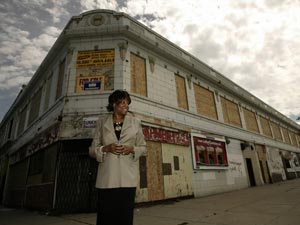
Compare this snapshot of an alderman at work in the illustration below, from an article that ran in the Tribune's business section last week (September 12, 2008).

2008-09-15-PatDowellWashingtonParkPhotobyTerrenceAntonioJames.jpg

Pat Dowell's Buffalo Park: There's Just More Room on the Sidewalks Down Here
(Source: Chicago Tribune. Photo by Terrence Antonio James)


Here we see a handsome photo of 3rd Ward Alderman Pat Dowell posing before a vacant commercial building. If you didn't already know the story, you could be forgiven for thinking that maybe this person hopes to be the next Jerry Kleiner, that the article is from the Food section, and that the dump behind her is on its way to becoming the next Red Light.

Not so. Dowell has no plans other than glamor photo shoots for the fire hazard behind her. Someone else does, however, and this makes her mad. She wants to protect her ward's inventory of empty buildings from people who might tear them down and build something that would attract tenants, customers, and tax revenue.

These pictures represent two different realities. Neither of them alone does justice to the equally insane but distinctly different dynamics of neighborhood development in Chicago. This diversity is clear to readers who leaf through the various sections of the Tribune , but it's a point that is lost in the tight muckraking focus of the "Neighborhoods for Sale" series.

The argument of "Neighborhoods for Sale" is not surprising. It's such a familiar story, in fact, that I feel like it could have been written before any of the research was done. Chicago aldermen, the argument goes, are in the pockets of real estate developers, who run rampant over the city's meaningless zoning code and run circles around the ineffectual wonks in its Department of Planning. In no other American city do planning and development work like this.

The results, which we are all familiar with, are the conspicuously over-sized, architecturally out-of-context, and often poorly constructed residential monstrosities that have come to symbolize the go-go years of the 1990s on the city's North Side. Plus fat-cat developers and corrupt aldermen.

All very well.

But if you think this series will help you understand how things work on the Near South Side, you're wrong. Or maybe it will, if you turn it upside down and hold it in a mirror. Community groups in the Near South Side shoo away developers, and aldermen run scared of community groups that have spent 40 years perfecting the techniques of obstruction. When they're not posing proudly in front of empty buildings.

Take the situation in Hyde Park, Barack Obama's home, and my neighborhood.

Community groups -- the kind that the "Neighborhoods For Sale" authors argue are typically kept out of ward-level decision-making -- killed a painfully negotiated compromise plan for Federally-funded renovation of the shoreline around Promontory Point in 2005. They spooked Alderman Leslie Hairston (5th) into blocking demolition of an empty hospital to make way for a Marriott in 2007, and are prepared to vote the precinct dry to block it again in 2008.

A handful of neighbors scared a developer away from replacing a derelict church that has been empty and falling apart since at least 1999; and yet another small group of people leaned into Alderman Toni Preckwinkle when she made it known that she favored a mixed-use residential project on a stretch of 53rd Street, presently home to a vacant lot and a car wash.

And Alderman Pat Dowell is offended that a private party, the University of Chicago, wants to horn in on her hoard of vacant lots and empty buildings.

Dowell's 3rd Ward: Forever Open, Clear, and Free

The "Neighborhoods for Sale" series performed a useful service in detailing the abuses to which the current development process is prone in the city of Chicago. It did not issue an authoritative diagnosis of the problem. That would have required looking at those large portions of the city where the issue is not too much development, but too little, and where community input is less the solution, and more of the problem.

[This post also appears at Huffington Post Chicago]

Wednesday, September 10, 2008

NIMBY's Corner: Rabid NIMBY Infects Bat on South Harper Avenue

posted by chicago pop

Bat Infected with Harper Avenue NIMBYism

Apparently, there's a bat problem on South Harper Avenue. According to this week's Herald headline, at least. But I think the Herald got it backwards, and is giving the bats down there a bad name. If anything is rabid, it's not the bats.

We've already covered our good neighbors' sensible fear of bar mitzvahs, and a general phobia of life being enjoyed by other people, as eloquently demonstrated by NIMBY's Corner repeat guest Allan Rechtschaffen: "There is concern about late-night noise from groups of alcohol-fueled merrymakers leaving hotel functions." (Hyde Park Herald LTE, September 10, 2008)

Now, we admit that parts of Harper Avenue, especially those closer to Vista Homes, are about as near to a graveyard as you can get, and aside from the seismic rumble of 2AM freight trains, are known as a place where local bats can slumber in peace while the Social Security checks fall like snow.

But let's not be ninnies: cities make a little noise, and if you can't deal, you should move to Wisconsin. In fact, I recommend that Alderman Hairston establish a TIF set-aside to purchase Wisconsin land for Hyde Parkers displaced by late-night bands of drunken historians.

Seriously, a few blocks south people worry about stray bullets. You're worried about drunken gastroenterologists?

But getting back to the "merry-makers": it should be noted, for the record, that when the tradition of Liberal Hyde Park activism settles upon a fear of public urination as its greatest principle, things have really bottomed out.

How is the Big 10 Frat Boy these folks are so scared of going to find his way all the way down Stony Island, then around and back up Harper Avenue, before deciding to urinate on the lawn of some multicolored Victorian home? Maybe the bar mitzvah revelers will lead him there?

Late-Night Merry-Maker Off to Harper Avenue

But there are still more serious questions, Mr. Rechtschaffen insists, and he already has the answers for them, and wonders why White Lodging hasn't done the studies to confirm what he already knows. "Parking will be a disaster" we're told. So forget the parking study. "All available street parking will be taken before drivers pay for hotel parking or use distal sites." You still want that study?

"Do we need such a large hotel?" the reader is asked. This expresses the concern that Mariott can't possibly be planning to make money by renting the rooms in its 17 stories. This would involve the "profit motive," and that doesn't function in Hyde Park outside the walls of the GSB.

With 2 million annual visitors to the MSI, thousands of professors, students, and staff associated with the University visiting every year, and no major hotels south of Roosevelt Road to service the south side of America's third largest city, there is no possible economic rationale for a 17 story hotel on Stony Island and 58th Street. Bats, look out!

I say scratch the hotel. What we need there is an executive, 24-hour helicopter pad.

Park it Next to Vista Homes, Please.

Sunday, September 7, 2008

The Coming Hyde Park Bar Mitzvah Ban

posted by chicago pop

A bar mitzvah ban? For what reason should you want to ban bar mitzvahs?

Ask the guy who showed up at the August 5th community meeting on the planned redevelopment of Hyde Park's Doctors Hospital. Among the many quixotic neighborhood objections to the construction of a Marriott hotel on the site at Stony Island and 58th Street, this one is at the top of the list.

To quote one of Hyde Park Progress' finest field reporters, who heard it all go down:

[T]here was the "threat of alcohol being served on the premises" and [that] it would endanger children who would somehow get hold of the stuff ... [O]ne man stood up and said alcohol would surely be a threat, because there would be Bar Mitzvahs in the function room.

Yes, you read that right. If voters of the 39th Precinct of Hyde Park's 5th Ward (Leslie Hairston) decide to exercise their "local option" to ban the sale of alcohol on November 4, they will effectively be banning the celebration of bar mitzvahs in their corner of the neighborhood.

Along with fun in general, together with the present and future possibility of a hotel with restaurants that serve alcohol, all of which are badly needed in our neighborhood. Through no animus to the Jewish religion, of course; it just seems that, in the eloquent words of this concerned citizen, whose foolishness we will keep shrouded in anonymity, bar mitzvahs are barn-burning, house-thumping bacchanals, where minors get a free pass to get drunk and loudly run around.

Which of course is true, as I plan my son's to be. But residents of the 39th Precinct don't want that. In a way it makes sense. It will be just one more thing that we will have to go and do on the north side, the only place where you can get rooms big enough to host fundraisers for Alderman Hairston, or bar mitzvah's for her constituents' children.

Banned!

The bar mitzvah issue hasn't been the only bizarre concern to arise from the profoundly sagacious bosom of the 39th Precinct.

Over the last year or so, a collection of Major and Minor Activists have advanced worries that the proposed Marriott building would "alter the air flow"; the same Major Activist and Very Minor Meteorologist who made that claim also argues that the hotel would cause an ailment previously unknown to science, called "urban claustrophobia"; and of course there is the complaint that the high-rise hotel would block views from the nearby Vista Homes, views over which no one has any legal or proprietary right.

Among the Minor Concerns heard are threats to the safety of children, obstruction of birds, threats to the safety of children, interference with the magnetic field of the Earth, more threats to the safety of children, and the overall destruction of the quality of life of happy homesteaders who like to park their cars for free on adjacent Harper Avenue, where life is quiet and there are no bar mitzvahs.


The interesting thing about how our devious local NIMBYs are using this legal maneuver is that, in most cases where Chicago precincts have been voted dry, it is to get rid of some liquor retail establishment that locals find offensive. In this case, to the contrary, it is to block any development from happening at all.

Typically, the targeted establishments are bars and liquor stores. Further typically, these establishments are thought to be vectors of crime and disorder, especially in poorer, ethnic neighborhoods. This is one reason Daley has been such an enthusiastic supporter of the local option city-wide.

The nearby 8th Ward, for example, has four local option referenda on the November ballot, as do precincts in the 13th and 19th Wards, both on the South Side. It is interesting to note that, while sensitive urban pioneers fret about liquor in gentrifying City neighborhoods, Chicago-area suburbs have trended away from prohibition, in pursuit of restaurants and the sales tax revenues they bring. The suburbs are more interested in pursuing the mechanics of urbanity than some neighborhoods within the city itself.

Alas, in Chicago, at least on the South Side, folks aren't terribly interested in these connections, or in making them happen. In the Big Sky Country of vacant lots and empty buildings, South Side community leaders have perfected the art, not of making things happen, but of taking things away: elevated spurs, liquor stores, public housing, and, with this referendum in the 39th Precinct of the 5th Ward, the very possibility of new development in the future.

All we need is buffalo to fill the empty space, and we've got ecotourism.

Let's drink to that!

[This post also appears on Huffington Post Chicago]

Thursday, August 21, 2008

Forget Preservation...PROHIBITION!

posted by Peter Rossi

Photo illustration by GFC

As you sit down to dinner in Hyde Park, the doorbell rings and you cringe: chances are it's either a solicitor or a "cause."

Residents of Harper and Stony Island Avenues opened their doors early this month to find a bearded NIMBY or one of his minions, armed with a petition. What was the petition about? It sought to put a referendum on November's ballot voting the 39th Precinct dry. "Dry," of course, means to prohibit the sale of alcohol in any commercial establishment. Hey, Hyde Park is already a nuclear-free zone, so why not also take aim at the devil's brew? Visions of corseted women being raped by drunken immigrants, children being neglected by their alcoholic parents, and Bar Mitzvahs gone mad drift into your head.

But no, this petition is pure subterfuge. The Bearded One is a longtime NIMBY who wants to halt development in Hyde Park. It's no accident that the 39th Precinct includes the old Doctors Hospital.

On the subject of Doctors Hospital, popular opinion appears to have turned against the NIMBYs, so how can they block the hotel project? It's easy: hotels depend on restaurants for profits, and restaurants depend on liquor licenses. There's no surer way to plow salt into the DH soil than to forbid the sale of alcohol.

But wait. Isn't this Bearded One the same man who stood up at the August 5th community meeting on Doctors Hospital and solemnly declared, "I'm in favor of development"? Isn't this the same person who insists he's not against a hotel, but merely wants the developer to "reuse" the existing building in the construction? Isn't this the same person who feigned righteous indignation when the developer, White Lodging, said "reuse" was not feasible for this project? How can this man be publicly in favor of development and "preservation" of the structure as a hotel, and at the same time go door-to-door, trying to submarine not only the proposed development but any future development?

Welcome to the Wonderful World of NIMBYs. They think the means justify the end, and that no one will hold them accountable for their outrageous actions.

Sunday, August 17, 2008

Pat Dowell Hates on U of C for Buying Empty Buildings and Vacant Lots


posted by chicago pop


Stop #1 on the Pat Dowell Anti-Development Tour

Chicago 3rd Ward Alderman Pat Dowell just had a NIMBY coming-out party.

Or at least it looks like she is trying to get in the Club. And nothing helps score some NIMBY street cred better than hating on the University of Chicago.

But it's not just hating on the U of C that makes you a NIMBY -- if that were the case, we'd have to include hundreds of College students -- it's how you hate on the U of C that makes you a NIMBY.

To really get street cred as a NIMBY, you have to be stuck in the 60s, the way Pat Dowell accused her 3rd Ward Aldermanic predecessor Dorothy Tillman of being "stuck in the 80s" before walloping her in the 2007 city council elections.

You have to believe, like the greatest Hyde Park NIMBYs, that what happened in the period of Urban Renewal, racial turnover, Civil Rights, and inner city decay formed a template that will forever govern the operation of Chicago politics.

You have to think that the grass-roots organizations that were formed then, over 2 generations ago, if not before (whether the Hyde Park Co-Op, the Harper Court Foundation or The Woodlawn Organization), are still relevant and effective, and that the stories these organizations tell about themselves are accurate interpretations of history.

Most importantly, when you get a chance to build something useful on a vacant lot or empty building, you say "No thanks," and make arguments about why you should be able to control and obstruct the buying and selling of private property.

Buy this land? How dare you!

Dowell makes it very clear what she wants in her letter, sent to U of C President Robert Zimmer, Mayor Daley, and, um, the Hyde Park Herald (August 13, 2008).

She doesn't want the University buying land in her ward
.

She says as much, referring to her "expressed reservations about the university purchasing land in the Third Ward at this time."

Dowell claims that the University is being high-handed by not bringing her in on its real estate plans, even though she has made it clear that she doesn't want the University in her neighborhood to begin with.

So why is she surprised she's not in the loop?

Even though NIMBY-ism clearly comes in a variety of colors, it still operates according to the same conservative and self-serving logic, in which paranoid speculations are cooked up on the basis of skewed understandings of changes that happened before a lot of us were born.

The 3rd Ward version of NIMBY-ism -- like one of Dorothy Tillman's hats, it can be taken off a hook and worn by anyone -- comes in a standard package that includes ritual incantations about the "history of the university's relationship with its neighboring communities."

We're all supposed to know what this means, we read about "the history" in the papers, University officials work through their guilt by endlessly admitting that there is a "history", when what this history really boils down to is one incident in Woodlawn that happened 50 years ago in utterly different historical circumstances, and with negative unintended consequences that have left that neighborhood worse off than if it hadn't experienced "the history" in the first place.

The story is this: in the early 1960s, the University of Chicago wanted to use federal urban renewal funds, with the support of municipal condemnations, to bulldoze and redevelop Woodlawn the way it had bulldozed parts of Hyde Park, which would have resulted in the displacement of low-income households the way it already had in Hyde Park.

Big Sky Country in Pat Dowell's 3rd Ward

Local folks mobilized to prevent this. It never happened. Local folks were happy, and then their neighborhood went to hell. Somewhere along the line, at the instigation of The Woodlawn Organization and now-convicted felon and former 20th Ward Alderman Arenda Troutman, they tore down the 63rd Street spur of the El, something increasingly regarded as one of the dumbest decisions in the history of mass transit.

Fast forward half a century: urban-renewed Hyde Park is a diverse community on the upswing, with its fabric more or less intact, anchored by the University of Chicago.

After The Woodlawn Organization achieved its goal of blocking University-led renewal of its eponymous neighborhood, however, it was unable to keep the area from descending into the very death spiral that the University had sought to forestall, losing population, businesses, and tax base over the next 30 years, as middle class blacks followed their white predecessors out the door.

That's a victory? Maybe not, but it provides a useful scapegoat.

This is the myth that Pat Dowell uses to impute Original Sin to the University of Chicago, and to try to score points with 3rd Ward constituents. It's a myth because the times have completely changed, though the racially charged NIMBY rhetoric has not.

My bet is that today's 3rd Ward voters can tell the difference (see Postscript).

The University is not purchasing land with the financial assistance of federal programs, and is not exercising eminent domain, as was done at the time of Urban Renewal. These purchases are not taking place at the height of the Civil Rights movement, when such actions were charged with political meanings and seemed to embody power relations that they no longer have.

Most unfortunately for the Woodlawn Myth of the Predatory University, the 3rd Ward purchases are taking place at the moment of a historic watershed, when inner cities have regained the interest of markets, imaginations, and entrepreneurs, and when smart, equitable urban development is seen to be a key to future sustainable habitation of our planet.

Garfield Green Line CTA Station (rebuilt 2001)

Any major revitalization of the south side wards around the University of Chicago will probably require the capital and involvement of the latter, in some form of public-private partnership that brings jobs to the neighborhood and builds on the efficiencies of existing urban infrastructure.

So let's put away the canned resentment and take advantage of an historic opportunity to get things moving down King Drive.

Either that, or the vacant lots in the 3rd Ward may collect garbage for another few generations.


Postscript

I was standing in the parkway of Garfield Boulevard taking these pictures of shuttered buildings, empty parking lots, and vacant land, when I was approached by a African American man about my age.

"You going to buy it?" he asked, pointing to the lot between King and Prairie.

"No," I said, "someone else already has."

"I hope they do something with it," the guy told me. "What we need around here are more jobs. These people want jobs. That building's been empty for 10 years. Someone needs to do something with it."

So I told him that the University of Chicago bought it, and some other lots around here, but that his Alderman Pat Dowell doesn't want the University to own land in her ward.

The guy didn't have a response to that. What he did say was that "we need development that pushes out the people who don't care about the neighborhood, and keeps the people who do."