Friday, September 19, 2008

Hans Morsbach: "I Am [Still] An Old Fart"

posted by chicago pop

About a year ago, Hans Morsbach gave an interview with the Chicago Maroon in which he described himself as an "old fart." ("Uncommon Interview: Hans Morsbach", October 23, 2007. )

For some strange reason the Maroon link no longer exists, but our original riff is here.

Since then, nothing has changed. Morsbach's is one of about 150-170 valid signatures on a petition to introduce the option for an alcohol ban in the 5th Ward's 39th Precinct on the November 4 ballot.

Although he complains about not being able to sell liquor on Hyde Park's 57th Street, and takes full advantage of the opportunity to sell liquor at a location in downstate Illinois, Morsbach doesn't want anyone to sell liquor in the 39th Precinct of the 5th Ward, site of Doctors Hospital.

That is to say, in his own backyard.

If you've followed HPP for any length of time, you'll know that Morsbach recently opened up a restaurant location in downstate Normal, Illinois, where he is raking in liquor revenue from a full-service beer hall near the campus of Illinois State University -- which he laments not being able to do in Hyde Park.

Here's how he described the merits of his new, downstate Medici in the above-cited Maroon article:

It's all about economics. We can have liquor, and it is in a good location close to Illinois State University.


If only students of the University of Chicago were so lucky!

But it gets even better. At pretty much the same time that Morsbach gave everyone a lecture about how the redevelopment of Harper Court would be like a sinful "Second Coming of Urban Renewal," he was taking advantage of a publicly subsidized, municipal land-clearance program in downtown Normal Illinois, setting up shop with his liquor license across the street from -- a Marriott Hotel!

Marriott Hotel Across the Street From Morsbach's Downstate Beer Hall

As with Marriott Hotels, so with booze: both are OK if they are in someone else's neighborhood and are served to someone else's kids.

Here's what his downstate menu has to say about it:

I'd Serve Booze in Hyde Park, But They Won't Let Me!

Humble Hyde Parkers may be forgiven if they, too, dream of something "more spectacular."

Alas, aspiring restauranteurs won't be able to "serve you a glass of wine to enjoy your meal" in the 39th Precinct because Hans Morsbach won't let them.

So Morsbach will be happy to serve you booze, you'll just have to drive 120 miles to get it. He'll take a stand against Urban Renewal in Hyde Park, and the University of Chicago, but not against Urban Renewal in Normal, or Illinois State University.

Residents of the Fighting 39th, you should be proud: those are some principles we can believe in.

Site of the "Second Coming"

Wednesday, September 17, 2008

What the Tribune's Zoning Series Missed

posted by chicago pop

Short answer: Half the story.

Longer answer: The Chicago Tribune's zoning series missed the half of the story that corresponds to the half of the city known as the South Side.

To understand how this is so, all you have to do is to compare two photographs from different sections of the same newspaper, the Chicago Tribune.

The first photo, below, is taken from the last in a 5-piece investigation by the Tribune into zoning, development, and corruption, "Neighborhoods for Sale", which ran from January to August of 2008.

2008-09-15-BernardStoneDevelopmentMeetingPhotobyAlexGarcia.jpg

Berny Stone: If You Don't Like My Plan The Guy to My Right Will Sit on You
(Source: Chicago Tribune. Photo by Alex Garcia)


Here we see Alderman Bernard Stone (50th) defending the proposed development of a retirement home in his community at a testy meeting with constituents who, according to interviews given to the Trib, largely oppose the plan. Why? Because an old-folks home, full of people in wheelchairs who don't drive to work, will supposedly cause traffic congestion.

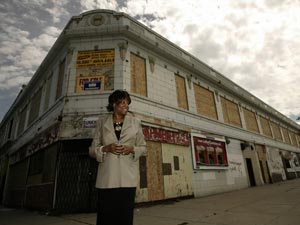
Compare this snapshot of an alderman at work in the illustration below, from an article that ran in the Tribune's business section last week (September 12, 2008).

2008-09-15-PatDowellWashingtonParkPhotobyTerrenceAntonioJames.jpg

Pat Dowell's Buffalo Park: There's Just More Room on the Sidewalks Down Here
(Source: Chicago Tribune. Photo by Terrence Antonio James)


Here we see a handsome photo of 3rd Ward Alderman Pat Dowell posing before a vacant commercial building. If you didn't already know the story, you could be forgiven for thinking that maybe this person hopes to be the next Jerry Kleiner, that the article is from the Food section, and that the dump behind her is on its way to becoming the next Red Light.

Not so. Dowell has no plans other than glamor photo shoots for the fire hazard behind her. Someone else does, however, and this makes her mad. She wants to protect her ward's inventory of empty buildings from people who might tear them down and build something that would attract tenants, customers, and tax revenue.

These pictures represent two different realities. Neither of them alone does justice to the equally insane but distinctly different dynamics of neighborhood development in Chicago. This diversity is clear to readers who leaf through the various sections of the Tribune , but it's a point that is lost in the tight muckraking focus of the "Neighborhoods for Sale" series.

The argument of "Neighborhoods for Sale" is not surprising. It's such a familiar story, in fact, that I feel like it could have been written before any of the research was done. Chicago aldermen, the argument goes, are in the pockets of real estate developers, who run rampant over the city's meaningless zoning code and run circles around the ineffectual wonks in its Department of Planning. In no other American city do planning and development work like this.

The results, which we are all familiar with, are the conspicuously over-sized, architecturally out-of-context, and often poorly constructed residential monstrosities that have come to symbolize the go-go years of the 1990s on the city's North Side. Plus fat-cat developers and corrupt aldermen.

All very well.

But if you think this series will help you understand how things work on the Near South Side, you're wrong. Or maybe it will, if you turn it upside down and hold it in a mirror. Community groups in the Near South Side shoo away developers, and aldermen run scared of community groups that have spent 40 years perfecting the techniques of obstruction. When they're not posing proudly in front of empty buildings.

Take the situation in Hyde Park, Barack Obama's home, and my neighborhood.

Community groups -- the kind that the "Neighborhoods For Sale" authors argue are typically kept out of ward-level decision-making -- killed a painfully negotiated compromise plan for Federally-funded renovation of the shoreline around Promontory Point in 2005. They spooked Alderman Leslie Hairston (5th) into blocking demolition of an empty hospital to make way for a Marriott in 2007, and are prepared to vote the precinct dry to block it again in 2008.

A handful of neighbors scared a developer away from replacing a derelict church that has been empty and falling apart since at least 1999; and yet another small group of people leaned into Alderman Toni Preckwinkle when she made it known that she favored a mixed-use residential project on a stretch of 53rd Street, presently home to a vacant lot and a car wash.

And Alderman Pat Dowell is offended that a private party, the University of Chicago, wants to horn in on her hoard of vacant lots and empty buildings.

Dowell's 3rd Ward: Forever Open, Clear, and Free

The "Neighborhoods for Sale" series performed a useful service in detailing the abuses to which the current development process is prone in the city of Chicago. It did not issue an authoritative diagnosis of the problem. That would have required looking at those large portions of the city where the issue is not too much development, but too little, and where community input is less the solution, and more of the problem.

[This post also appears at Huffington Post Chicago]

Sunday, September 14, 2008

Doctor's Hospital Petition: Hypocrites or Blackmailers?

posted by Peter Rossi

On November 4th, residents of the 39th precinct will vote on a referendum to make their precinct dry. Opponents of a hotel at the Doctor's Hospital site gathered the 150 signatures required from the 600 odd registered voters in this tiny precinct. A simple majority of those who vote on the referendum is needed to prevail. That means that only a handful of voters will determine the future of commercial development in HP.

An interesting soup of local "preservation" activists, labor organizers, university employees, and students canvassed for signatures.

Several of the petition circulators are local "preservationists" who are on public record as favoring a "re-use" of the existing Doctor's Hospital buildings. I reproduce two petition forms that were circulated by these "preservationists" below.

So much for "we want good development not this development" and "I'm in favor of a hotel; I just want preservation" and "I'm pro-development." Exploiting an absurd 1934 Illinois law, these folks have turned tail on their preservation roots. Voting this precinct dry will make any mixed used development infeasible, including re-use of the existing buildings. In all probability, the passage of this referendum would condemn the Doctor's Hospital Buildings to remain vacant indefinitely.

Would any developer come to Hyde Park after the cross has been burned on the lawn of Doctor's Hospital? Not likely, "those people are crazy; they would hurt themselves to avoid a restaurant or hotel in their neighborhood." So this petition has the potential to do great harm to Hyde Park and surrounding communities.

This looks pretty bad for the track record of some of the same folks who opposed development at McMobil, on Cornell, at St. Stephens, oppose fixing the Point, and want to gum up the works at Harper Court. They are more like undertakers than preservationists.

The sponsors of the petition have now signaled that this was all about a spot of blackmail. Vista Homes resident and winner of the petition sweepstakes, Mr. Rechtschaffen, let the cat of the bag in a letter in the Herald. Well, we want you (the developer and the U) to play ball; we aren't necessarily that interested voting the precinct dry. The head of the HP-KCC Preservation committee approached University officials and intimated that he didn't think the petition "had to go through," wink, wink.

Ah, the Prince would be proud of his HP proteges. They don't give a damn about preservation, they just want to hold feet to the fire. To what end, though? Mr. Rechschaffen is concerned about parking and noise. It's not clear he has any solution other than no hotel. He dances around the idea of a smaller hotel but this doesn't really help with his noise problem.

Mr. Lane of Harper Ave is even more obvious, "this has always been about the community process not the hotel." Translation: we want say in this project. We don't really care about the outcome; we just want power. Our other NIMBY friend is shy, or should I say sly, and doesn't say.

This was all accomplished by some pretty cynical political maneuvering. Our NIMBY handful went to some of their close neighbors at Vista Homes and Harper Ave and said "I know you are nervous about change, don't trust the wicked developer and arrogant U; let's slow this whole thing down." Well, they haven't "slowed it" down. In this kind of high stakes game, there is only go or no go. If the petition passes, this dooms the site and probably our neighborhood to no commercial development for some time.

The doomsday machine has been turned on. Does anyone seriously think that Mr. Rechtschaffen, Mr. Lane or the man behind the curtain are going to turn it off? Are they going to go door to door to tell their neighbors -- "Just kidding on that petition, the developer licked our boots clean, please vote NO?"

In the end, reasonable people will prevail and this measure will be defeated. Folks in the 39th will think it through and point the gun away from their foot.

The real question is will our students of Machiavelli be held accountable for this irresponsible act?

Next week: Anatomy of A Blackmail. A look at how this was set in the motion with the aid of local 1, Unite-HERE.


Friday, September 12, 2008

Antheus Capital Takes on the Shoreland

posted by Peter Rossi

Last week, Antheus Capital purchased the former Shoreland Hotel for $16,000,000. Antheus Capital owns an number of rental properties in the Hyde Park area and has two other major projects in various stages of production (Solstice in the Park (a 26 story condo at 56th and Cornell) and Village Center (a makeover of the Village Shopping Center at Hyde Park and Lake Park Blvds)).

At the current time, Antheus Capital is said to be studying the possibilities at the Shoreland. One nifty idea would be to make one wing of the massive former hotel just that -- a boutique hotel and leave the other to condos. In any event, this will be sure to draw NIMBY fire (aren't those condo owners noisy!). It may also add fuel to the "big is bad" argument (did you hear that Antheus Capital is partnering with Walmart?).

I'm delighted to see some positive movement. The Shoreland has a great location and is a grand old dame. One request please: Eli, can you please restore the portion of the cornice that was "repaired" by our dirt poor U? You know, the section in the middle with the sheet-metal covering that looks like it belongs in Naperville. But, I'm not going to threaten to vote you dry to get this. I put my trust in the profit motive - who wants to buy a condo or rent a hotel room in a building with a prominent missing tooth?

Wednesday, September 10, 2008

NIMBY's Corner: Rabid NIMBY Infects Bat on South Harper Avenue

posted by chicago pop

Bat Infected with Harper Avenue NIMBYism

Apparently, there's a bat problem on South Harper Avenue. According to this week's Herald headline, at least. But I think the Herald got it backwards, and is giving the bats down there a bad name. If anything is rabid, it's not the bats.

We've already covered our good neighbors' sensible fear of bar mitzvahs, and a general phobia of life being enjoyed by other people, as eloquently demonstrated by NIMBY's Corner repeat guest Allan Rechtschaffen: "There is concern about late-night noise from groups of alcohol-fueled merrymakers leaving hotel functions." (Hyde Park Herald LTE, September 10, 2008)

Now, we admit that parts of Harper Avenue, especially those closer to Vista Homes, are about as near to a graveyard as you can get, and aside from the seismic rumble of 2AM freight trains, are known as a place where local bats can slumber in peace while the Social Security checks fall like snow.

But let's not be ninnies: cities make a little noise, and if you can't deal, you should move to Wisconsin. In fact, I recommend that Alderman Hairston establish a TIF set-aside to purchase Wisconsin land for Hyde Parkers displaced by late-night bands of drunken historians.

Seriously, a few blocks south people worry about stray bullets. You're worried about drunken gastroenterologists?

But getting back to the "merry-makers": it should be noted, for the record, that when the tradition of Liberal Hyde Park activism settles upon a fear of public urination as its greatest principle, things have really bottomed out.

How is the Big 10 Frat Boy these folks are so scared of going to find his way all the way down Stony Island, then around and back up Harper Avenue, before deciding to urinate on the lawn of some multicolored Victorian home? Maybe the bar mitzvah revelers will lead him there?

Late-Night Merry-Maker Off to Harper Avenue

But there are still more serious questions, Mr. Rechtschaffen insists, and he already has the answers for them, and wonders why White Lodging hasn't done the studies to confirm what he already knows. "Parking will be a disaster" we're told. So forget the parking study. "All available street parking will be taken before drivers pay for hotel parking or use distal sites." You still want that study?

"Do we need such a large hotel?" the reader is asked. This expresses the concern that Mariott can't possibly be planning to make money by renting the rooms in its 17 stories. This would involve the "profit motive," and that doesn't function in Hyde Park outside the walls of the GSB.

With 2 million annual visitors to the MSI, thousands of professors, students, and staff associated with the University visiting every year, and no major hotels south of Roosevelt Road to service the south side of America's third largest city, there is no possible economic rationale for a 17 story hotel on Stony Island and 58th Street. Bats, look out!

I say scratch the hotel. What we need there is an executive, 24-hour helicopter pad.

Park it Next to Vista Homes, Please.

Sunday, September 7, 2008

The Coming Hyde Park Bar Mitzvah Ban

posted by chicago pop

A bar mitzvah ban? For what reason should you want to ban bar mitzvahs?

Ask the guy who showed up at the August 5th community meeting on the planned redevelopment of Hyde Park's Doctors Hospital. Among the many quixotic neighborhood objections to the construction of a Marriott hotel on the site at Stony Island and 58th Street, this one is at the top of the list.

To quote one of Hyde Park Progress' finest field reporters, who heard it all go down:

[T]here was the "threat of alcohol being served on the premises" and [that] it would endanger children who would somehow get hold of the stuff ... [O]ne man stood up and said alcohol would surely be a threat, because there would be Bar Mitzvahs in the function room.

Yes, you read that right. If voters of the 39th Precinct of Hyde Park's 5th Ward (Leslie Hairston) decide to exercise their "local option" to ban the sale of alcohol on November 4, they will effectively be banning the celebration of bar mitzvahs in their corner of the neighborhood.

Along with fun in general, together with the present and future possibility of a hotel with restaurants that serve alcohol, all of which are badly needed in our neighborhood. Through no animus to the Jewish religion, of course; it just seems that, in the eloquent words of this concerned citizen, whose foolishness we will keep shrouded in anonymity, bar mitzvahs are barn-burning, house-thumping bacchanals, where minors get a free pass to get drunk and loudly run around.

Which of course is true, as I plan my son's to be. But residents of the 39th Precinct don't want that. In a way it makes sense. It will be just one more thing that we will have to go and do on the north side, the only place where you can get rooms big enough to host fundraisers for Alderman Hairston, or bar mitzvah's for her constituents' children.

Banned!

The bar mitzvah issue hasn't been the only bizarre concern to arise from the profoundly sagacious bosom of the 39th Precinct.

Over the last year or so, a collection of Major and Minor Activists have advanced worries that the proposed Marriott building would "alter the air flow"; the same Major Activist and Very Minor Meteorologist who made that claim also argues that the hotel would cause an ailment previously unknown to science, called "urban claustrophobia"; and of course there is the complaint that the high-rise hotel would block views from the nearby Vista Homes, views over which no one has any legal or proprietary right.

Among the Minor Concerns heard are threats to the safety of children, obstruction of birds, threats to the safety of children, interference with the magnetic field of the Earth, more threats to the safety of children, and the overall destruction of the quality of life of happy homesteaders who like to park their cars for free on adjacent Harper Avenue, where life is quiet and there are no bar mitzvahs.


The interesting thing about how our devious local NIMBYs are using this legal maneuver is that, in most cases where Chicago precincts have been voted dry, it is to get rid of some liquor retail establishment that locals find offensive. In this case, to the contrary, it is to block any development from happening at all.

Typically, the targeted establishments are bars and liquor stores. Further typically, these establishments are thought to be vectors of crime and disorder, especially in poorer, ethnic neighborhoods. This is one reason Daley has been such an enthusiastic supporter of the local option city-wide.

The nearby 8th Ward, for example, has four local option referenda on the November ballot, as do precincts in the 13th and 19th Wards, both on the South Side. It is interesting to note that, while sensitive urban pioneers fret about liquor in gentrifying City neighborhoods, Chicago-area suburbs have trended away from prohibition, in pursuit of restaurants and the sales tax revenues they bring. The suburbs are more interested in pursuing the mechanics of urbanity than some neighborhoods within the city itself.

Alas, in Chicago, at least on the South Side, folks aren't terribly interested in these connections, or in making them happen. In the Big Sky Country of vacant lots and empty buildings, South Side community leaders have perfected the art, not of making things happen, but of taking things away: elevated spurs, liquor stores, public housing, and, with this referendum in the 39th Precinct of the 5th Ward, the very possibility of new development in the future.

All we need is buffalo to fill the empty space, and we've got ecotourism.

Let's drink to that!

[This post also appears on Huffington Post Chicago]

Saturday, September 6, 2008

A Herald Tribute in Words and Song


posted by Richard Gill

Does the Hyde Park Herald really want to destroy Hyde Park? One might think so, with the way the Herald has a record of shrieking in support for moribund, counterproductive institutions, as it did for the old Co-op.

More to the point, at present, is the Herald's pitiful and ill-spirited attempt to spread paranoia and to demonize the University of Chicago. I am talking about the Herald's treatment of the University's recent land purchases west of Washington Park.

Apparently unwilling to write balanced news on the subject, the Herald has resorted to publishing a biased, one-sided article, complete with screaming front-page headline, but calling it an "editorial." In this "editorial," the Herald does not directly state its position; the paper just writes the article in a one-sided manner. That way, the Herald can take sides in its news coverage, while hiding behind the false label of the editorial.

Take a look at what the Herald did on September 3, 2008. No editorial page was published in the regular edition. That was odd, I thought; the Hyde Park Herald, with no sophomoric opinion page? Then I looked at the Herald Extra, which like the Herald is published weekly on the same dates. Usually, the Extra is a throwaway ad paper. But not on September 3. On the front page is a green banner proclaiming "Herald Editorial." Below that, in three-quarter-inch-high headline type is "U. of C. ad campaign denies secrecy." That's a news headline, not an editorial headline. The article is written totally from the perspective of 3rd Ward Alderman Pat Dowell, who purports to dislike the University's purchase of property in the ward "without her knowledge" and "not respecting her authority." (Last I heard, property purchases don't require an alderman's prior knowledge or permission, but that's another topic).

There's no above-board Herald opinion in this September 3 piece; it's all Dowell's opinions and actions: Dowell released, Dowell's charge, Dowell's concern, Dowell expressed anger, Dowell said. If the Herald has a policy position on this issue, they haven't shown the courage to say what it is. It's a lot easier to simply spread fear and loathing.

Why didn't the Herald publish this sorry piece on the front page of the main paper? Maybe that would've been just too far off the sleaze chart. No, better to put it in a supplement like the Extra. Nobody cares about journalistic standards there.....uh right, Herald?

Herald, your September 3 so-called "editorial" was cowardly and sneaky. Herald, old buddy, you've been caught. Busted. You're not even good at yellow journalism.


Wednesday, September 3, 2008

Blogs You Should Read and Things You Should Eat

Very Sexy Italian Espresso Machine That May Soon Be Living at
Zalesky Und Horvath Market Cafe

posted by chicago pop

Now that the break in geological time known as Labor Day has passed, and the boat pond in Harold Washington Park has managed to be full of water for half the summer, though not full of boats, I'd like to direct your attention to some of the following developments in the greater Hyde Park/Southside, both in and out of the blogosphere:

Woodlawn Wonder, the dynamic and quite entertaining voice of I Hate my Developer, describes being too close for comfort to the insane spate of gunshots in mid-August, some of which were directed at CTA buses on Stony Island and 65th Street, down the street from her ranch and the future south campus U of C dormitories.

I am appropriately horrified, even from the distance of 47th Street. And the tragic gunfire continues.

Looks like you can have firearms and mayhem even without a decrepit elevated spur along 63rd Street.

You might also read her narration of our first face-to-face meeting, in which we observed her handling table service for at least two successive tables of families with kids, all with impeccable aplomb. From our conversation that evening, it sounds like things are looking up for Woodlawn Wonder. You can cheer for her when you check out her blog.

Meanwhile, another little shop appears poised to enter the local retail landscape: Open Produce, at 1635 E. 55th Street, tells me that they're in the last stages of their build-out, and hope to win their last duel with City inspectors in the next few weeks, which you can read about on their blog.

They have some remodeling pics on the blog, which like the shots J/Tati put up of his shop when his ceiling collapsed earlier this year, remind us how crappy a lot of the lead-paint death-trap retail space in Hyde Park really is. (We note that Tati's old basement shop at 55th and Cornell is still vacant. Low rent with free lead poisoning, anyone?)

Back on topic, here's what the Open Produce folks say about themselves:

Open Produce ... will provide as many fruits and vegetables (conventional, organic, local, really local) and dry goods as we can fit in our storefront. In addition to providing good food at good prices, we also want to push the envelope in terms of transparency and accountability to the community -- all of our bank statements, wholesale prices, contractor payments, employee wages, etc. will be made available for everyone to scrutinize.


"Social entrepreneurialism" it's called, and it looks like the next generation of Hyde Park innovation with some interesting bells and whistles. We'll see if it marks an improvement over what came before when it comes to the bottom line: quality goods, quality service, and reliable operation. Our fingers are crossed.

Meanwhile, of course, our favorite "Zig and Lou" has been blogging about the long-awaited arrival of the Zaleski & Horvath Market Cafe at 1126 E. 47th Street, undoubtedly named after the well-known Polish-Hungarian retail merchants who bring their business acumen, and taste in finer imported foods, here from the Old Country.

Can't wait to meet them and tell dirty jokes in Yiddish.

Read about blogger Z&L's meetings with "cheese reps," the joys of having ComEd inspectors come over, the punctuality of City inspectors, and the super hot technology that is going to make Z&H the hippest Polish-Hungarian outpost in the neighborhood. There's more to learn here about opening a small business in Chicago than I've found anywhere else.

You know we've been cheering for this one for a long time. With Z&H and Open Produce hopefully here this fall, we could be eating very well indeed. Stay tuned.

Companion to the Other Very Sexy Italian Espresso Machine Above


Sunday, August 24, 2008

Road Trip!


We'll be taking a holiday from the unending Hyde Park media circus (for which we provide a tent) over the next week or so.

Time to bond with the dogs, go to the shore, jump in the lake, and otherwise slack off.

See you in September.

Thursday, August 21, 2008

Forget Preservation...PROHIBITION!

posted by Peter Rossi

Photo illustration by GFC

As you sit down to dinner in Hyde Park, the doorbell rings and you cringe: chances are it's either a solicitor or a "cause."

Residents of Harper and Stony Island Avenues opened their doors early this month to find a bearded NIMBY or one of his minions, armed with a petition. What was the petition about? It sought to put a referendum on November's ballot voting the 39th Precinct dry. "Dry," of course, means to prohibit the sale of alcohol in any commercial establishment. Hey, Hyde Park is already a nuclear-free zone, so why not also take aim at the devil's brew? Visions of corseted women being raped by drunken immigrants, children being neglected by their alcoholic parents, and Bar Mitzvahs gone mad drift into your head.

But no, this petition is pure subterfuge. The Bearded One is a longtime NIMBY who wants to halt development in Hyde Park. It's no accident that the 39th Precinct includes the old Doctors Hospital.

On the subject of Doctors Hospital, popular opinion appears to have turned against the NIMBYs, so how can they block the hotel project? It's easy: hotels depend on restaurants for profits, and restaurants depend on liquor licenses. There's no surer way to plow salt into the DH soil than to forbid the sale of alcohol.

But wait. Isn't this Bearded One the same man who stood up at the August 5th community meeting on Doctors Hospital and solemnly declared, "I'm in favor of development"? Isn't this the same person who insists he's not against a hotel, but merely wants the developer to "reuse" the existing building in the construction? Isn't this the same person who feigned righteous indignation when the developer, White Lodging, said "reuse" was not feasible for this project? How can this man be publicly in favor of development and "preservation" of the structure as a hotel, and at the same time go door-to-door, trying to submarine not only the proposed development but any future development?

Welcome to the Wonderful World of NIMBYs. They think the means justify the end, and that no one will hold them accountable for their outrageous actions.

Sunday, August 17, 2008

Pat Dowell Hates on U of C for Buying Empty Buildings and Vacant Lots


posted by chicago pop


Stop #1 on the Pat Dowell Anti-Development Tour

Chicago 3rd Ward Alderman Pat Dowell just had a NIMBY coming-out party.

Or at least it looks like she is trying to get in the Club. And nothing helps score some NIMBY street cred better than hating on the University of Chicago.

But it's not just hating on the U of C that makes you a NIMBY -- if that were the case, we'd have to include hundreds of College students -- it's how you hate on the U of C that makes you a NIMBY.

To really get street cred as a NIMBY, you have to be stuck in the 60s, the way Pat Dowell accused her 3rd Ward Aldermanic predecessor Dorothy Tillman of being "stuck in the 80s" before walloping her in the 2007 city council elections.

You have to believe, like the greatest Hyde Park NIMBYs, that what happened in the period of Urban Renewal, racial turnover, Civil Rights, and inner city decay formed a template that will forever govern the operation of Chicago politics.

You have to think that the grass-roots organizations that were formed then, over 2 generations ago, if not before (whether the Hyde Park Co-Op, the Harper Court Foundation or The Woodlawn Organization), are still relevant and effective, and that the stories these organizations tell about themselves are accurate interpretations of history.

Most importantly, when you get a chance to build something useful on a vacant lot or empty building, you say "No thanks," and make arguments about why you should be able to control and obstruct the buying and selling of private property.

Buy this land? How dare you!

Dowell makes it very clear what she wants in her letter, sent to U of C President Robert Zimmer, Mayor Daley, and, um, the Hyde Park Herald (August 13, 2008).

She doesn't want the University buying land in her ward
.

She says as much, referring to her "expressed reservations about the university purchasing land in the Third Ward at this time."

Dowell claims that the University is being high-handed by not bringing her in on its real estate plans, even though she has made it clear that she doesn't want the University in her neighborhood to begin with.

So why is she surprised she's not in the loop?

Even though NIMBY-ism clearly comes in a variety of colors, it still operates according to the same conservative and self-serving logic, in which paranoid speculations are cooked up on the basis of skewed understandings of changes that happened before a lot of us were born.

The 3rd Ward version of NIMBY-ism -- like one of Dorothy Tillman's hats, it can be taken off a hook and worn by anyone -- comes in a standard package that includes ritual incantations about the "history of the university's relationship with its neighboring communities."

We're all supposed to know what this means, we read about "the history" in the papers, University officials work through their guilt by endlessly admitting that there is a "history", when what this history really boils down to is one incident in Woodlawn that happened 50 years ago in utterly different historical circumstances, and with negative unintended consequences that have left that neighborhood worse off than if it hadn't experienced "the history" in the first place.

The story is this: in the early 1960s, the University of Chicago wanted to use federal urban renewal funds, with the support of municipal condemnations, to bulldoze and redevelop Woodlawn the way it had bulldozed parts of Hyde Park, which would have resulted in the displacement of low-income households the way it already had in Hyde Park.

Big Sky Country in Pat Dowell's 3rd Ward

Local folks mobilized to prevent this. It never happened. Local folks were happy, and then their neighborhood went to hell. Somewhere along the line, at the instigation of The Woodlawn Organization and now-convicted felon and former 20th Ward Alderman Arenda Troutman, they tore down the 63rd Street spur of the El, something increasingly regarded as one of the dumbest decisions in the history of mass transit.

Fast forward half a century: urban-renewed Hyde Park is a diverse community on the upswing, with its fabric more or less intact, anchored by the University of Chicago.

After The Woodlawn Organization achieved its goal of blocking University-led renewal of its eponymous neighborhood, however, it was unable to keep the area from descending into the very death spiral that the University had sought to forestall, losing population, businesses, and tax base over the next 30 years, as middle class blacks followed their white predecessors out the door.

That's a victory? Maybe not, but it provides a useful scapegoat.

This is the myth that Pat Dowell uses to impute Original Sin to the University of Chicago, and to try to score points with 3rd Ward constituents. It's a myth because the times have completely changed, though the racially charged NIMBY rhetoric has not.

My bet is that today's 3rd Ward voters can tell the difference (see Postscript).

The University is not purchasing land with the financial assistance of federal programs, and is not exercising eminent domain, as was done at the time of Urban Renewal. These purchases are not taking place at the height of the Civil Rights movement, when such actions were charged with political meanings and seemed to embody power relations that they no longer have.

Most unfortunately for the Woodlawn Myth of the Predatory University, the 3rd Ward purchases are taking place at the moment of a historic watershed, when inner cities have regained the interest of markets, imaginations, and entrepreneurs, and when smart, equitable urban development is seen to be a key to future sustainable habitation of our planet.

Garfield Green Line CTA Station (rebuilt 2001)

Any major revitalization of the south side wards around the University of Chicago will probably require the capital and involvement of the latter, in some form of public-private partnership that brings jobs to the neighborhood and builds on the efficiencies of existing urban infrastructure.

So let's put away the canned resentment and take advantage of an historic opportunity to get things moving down King Drive.

Either that, or the vacant lots in the 3rd Ward may collect garbage for another few generations.


Postscript

I was standing in the parkway of Garfield Boulevard taking these pictures of shuttered buildings, empty parking lots, and vacant land, when I was approached by a African American man about my age.

"You going to buy it?" he asked, pointing to the lot between King and Prairie.

"No," I said, "someone else already has."

"I hope they do something with it," the guy told me. "What we need around here are more jobs. These people want jobs. That building's been empty for 10 years. Someone needs to do something with it."

So I told him that the University of Chicago bought it, and some other lots around here, but that his Alderman Pat Dowell doesn't want the University to own land in her ward.

The guy didn't have a response to that. What he did say was that "we need development that pushes out the people who don't care about the neighborhood, and keeps the people who do."

Friday, August 15, 2008

Herald's Chicken: How to Write a Slanted Account of the DH Meeting


posted by Peter Rossi

The NIMBYs who oppose a hotel on the Doctor's Hospital site were hopping mad after the August 5th "community" meeting. There were a number of people who had the temerity to question the knee jerk "preservation" and "congestion" arguments trotted out by various Harper Ave regulars. Even the 5th ward alderman was showing signs of a backbone on this issue.

I can only imagine the panic in the air during the weekly "editorial" meetings with Herald staff. Aren't we going to be forced to reveal some of the truth about Doctor's Hospital? Not to worry, our trusty Herald reporters and editors will figure a way to downplay the bad news and distort the account of the meeting.

Once again, the Herald came thru with a doozy ("Drs. Hospital, take 2"). All of the tricks of the trade are present in this minor masterpiece of distortion:
1. reversing the order of importance of the events at the meeting
2. selective omission of important facts
3. paint the Harper boys as heroes and the White Lodging executive as evil and slippery
4. Misquote where possible
5. Don't actually do any reporting (such as interviewing people and questioning them on the logical and factual basis for their assertions).
6. Don't report rude behavior and rather insane or inane remarks from opponents.

For the facts, read Richard Gill's post below this one. DO NOT read the Herald story as it might be hazardous to your judgment!

The article starts out with a couple of paragraphs on how the community and Leslie Hairston shoed away evil White Lodging and they came crawling back in the person of Scott Travis.

I don't really know what happened to tip the Alderman but I suspect that what this is all about is that White Lodging didn't put in time in Alderman Hairston's throne room. This has nothing to do with community protests as it is clear that nothing really has changed in the year or so since the original community farce. The Herald claims that White Lodging "clashed" with community "denizens" (are these small animals found at the bottom of ponds?). This sounds like White Lodging running roughshod over residents. What happened is a few cranks shouted down reasonable discourse with nonsense about the "historic" value of this eyesore and concerns that they wouldn't be able to put those chairs out in Harper Ave to reserve their personal parking spaces.

The real news from the August 5th meeting is twofold: 1. Alderman Hairston sees the writing on the wall - it's White Lodging or nothing (where is the long line of folks willing to pony up $70 million?) and 2. there are large number of responsible people in the community who would love to see White Lodging build a hotel. A subplot is that preservation of DH is dead. Preservation advocates have consistently refused to explain why this mediocre relic of institutional architecture is worth saving. If this wasn't obvious before the meeting, it sure is now!

To get the real news from the Herald story you have to turn to the continuation on page 3 and wade thru several attempts to disguise this important fact. In paragraph 10 of 19, Ms. Hawley asserts that the "majority favored development." Of course, our NIMBYs claim they favor "development," you see, just not development as White Lodging proposes it. The fact is that a very substantial group of people (I think about 1/2 of the attendees once you subtract the outside labor organizers in the red t-shirts) want a modern hotel and would like to see DH torn down.

The "preservationists" have tried to spread the impression that "preservation" is possible and might even be cheaper by virtue of tax credits. The Herald fell for this tact, hook, line and sinker. In fact, the paper was so eager to advance this point of view that words were put into Landmarks Illinois president Jim Peter's mouth. The story incorrectly asserts that Peters claimed "federal tax credits ... would make a hotel conversion cost-effective." Mr. Peters did not say this. As he is well aware, this would be irresponsible to say as there are no cost estimates for "conversion" or "reuse" plans. Mr. Peters did bring up the tax credits but was careful not to make the leap of faith. As we all know, tax credits for building gold mountains don't mean that gold mountains are cost-effective.

The Herald also choose to omit one of the most persuasive speakers, a spokesman for the Museum of Science and Industry. She told the group that visitors to the museum are constantly asking about nearby hotel accommodations and that MSI staff have to refer them downtown. In addition, the museum offered its 1500 space underground parking garage as overflow for valet parking.

The selective omission continues as the Herald reports that residents of Vista Homes asked for environmental and traffic studies. This is correct but the Herald fails to report that there was a traffic study done by White Lodging that showed minimal impact and that an environmental study was done prior to the U of Chicago purchase.

Sometimes, the Herald just gets plain frustrated that people are not towing the NIMBY line and quotes are fabricated. One of the most ridiculous suggestions made by opponents of a hotel is that there should be a "masterplan" for development of Stony Island Avenue between 56th and 59th Streets. U of C Vice President Susan Campbell pointed out the absurdity of a "masterplan" for the west side (the east side is a park) of only three blocks and then patiently explained that the U doesn't own all of this property. Somehow all this was forgotten and Ms. Campbell is quoted as saying that a masterplan is "a good idea."

Just as the Herald saw fit to omit details of some of the most persuasive arguments for the hotel, the paper saw fit to omit the rude behavior and demagoguery of some of the opponents. The labor organizers attempted to disrupt the meeting by forcing a vote on whether the hotels would be a union shop. One particularly addled NIMBY cautioned that out of control Bar Mitzvahs might corrupt the Bret Harte kiddies. Longtime demagogue, Greg Lane, delivered a scripted speech about how we should demand "good" development not just "any" development. Mr. Lane was a little short on how he would raise $70 million for "good" development if we are not able to take the "dirty money" of White Lodging.

When NIMBYs don't like being confronted with the truth, they parody those who speak the truth. The preservationists were dealt a severe blow when it was pointed out to them by both Mr. Travis and Leon Finney that the DH is sort of a monument to racism. Built as a hospital for Illinois Central employees, the hospital had a policy of not admitting black patients. Of course, the Herald doesn't explain this fact as it might be verified by the reader. Instead, Mr. Travis is blamed -- "he tossed out another, previously unheard argument into the mix: the hospital has an ugly history of discrimination..." This way it is not clear whether or not assertion is true or just an invective from Mr. Travis.

The next paragraph detailing Leon Finney's support for the hotel and corroboration of the discrimination against blacks is cleverly written so that you have to dissect it carefully to see that Mr. Finney agreed with Mr. Travis. From "Finney" to "agreed" there are no less than 11 words. This remind me of Mark Twain's essay on how to read a German sentence -- go to the end and get the verb!

The NIMBYs didn't like Marcy Schlessinger's remarks about why the hotel is not reusable. We can't refute the fact that the SECC did study this, so let's paint her as biased by reminding folks that the SECC receives its funding from the U. Never mind that Ms. Schlessinger was there of her own volition and has no particular reason to be beholden to the U.

But the real problem with this article is that there is no actual reporting in it! A reporter should interview the various key players and do some homework. Ok, Mr. Preservationist why is this building historically significant? How much would your re-use proposal cost and why did White Lodging claim that it is not feasible? Ok, Mr. Travis, give me copies of your analysis of the re-use proposal and your traffic study. Ok, Ms. MSI give me an estimate of the number of rooms you could refer each year. Ok, Mr. Labor Organizer in the red t-shirt, what is your name and where do you live and are you being paid to attend this meeting? Give me documentation of the "shoddy labor practices" not rumors. Our own Chicago Pop did a little bit of reporting in just a few minutes and found out that there is no substantiation of these claims.

Is the Herald a newspaper or a NIMBY newsletter?

Sunday, August 10, 2008

Doctors Hospital Redevelopment Meeting, August 5, 2008

posted by Richard Gill


I'll begin by saying that I think the meeting overall was positive, with very strong support for a hotel on the Doctors Hospital site. Further, I believe the meeting removed any impression that there is broad sentiment in the neighborhood for saving the Doctors Hospital building or any part of it. The meeting was at times difficult, but people came out and spoke their minds, and the "Hyde Park Establishment" did not dominate the meeting.

I'm glad to say that those who spoke in favor of the hotel project (and did not object to the demolition of the old building) behaved themselves, and kept their remarks brief and to the point. The speech making, irrelevancies, non sequiturs, interruptions, and one major attempt at disruption, came from naysayers, die hard "preservationists", people who dislike the U of C, and people with political agendas. That noisy, time-consuming stuff clearly irritated Alderman Hairston, who ran the meeting, and she was able to cut it off most times.

Throughout the one-hour, forty minute meeting, Alderman Hairston did a good job of walking the tightrope between letting people vent and keeping the meeting on track. Several times, she made it clear that this is a private project, and most decisions are up to the developer (White Lodging).

It was standing-room-only by the time the meeting started at 6:15PM. About 200 people were seated in the Bret Harte Elementary School gym, and dozens more lined the walls or stood in the corridor outside the room. At least 20 people in red t-shirts reading UNITE HERE were in the room, occupying as many seats at the front of the room.

Alderman Hairston opened the meeting with a background statement, saying the meeting follows on earlier input from the community. She said that earlier input told her that the community does not want the Doctors Hospital building to remain dormant, nor does the community want it bulldozed. She said she wanted White Lodging to listen and take ideas back with them. She said a concern is to ensure fair labor practices. Finally, she said she wants the community to feel good about what happens with the site.

The first question that came to my mind was, when did "the community" determine it doesn't want the building taken down?

Scott Travis of White Lodging presented the company's plan for a 390-room hotel/15,000 sq. ft. function room with a $60-70 million investment. Then the mike was passed around for Q&A.

Yes, all the usual issues came up: parking, "congestion", design compatible with "the community," the U of C controls it all, let's make the building a nursing home, and let's have more "master planning" and more studies and more meetings, and how do we know that the construction work won't damage Vista Homes? That stuff pretty much didn't seem to fly with Hairston.

White Lodging was accused of having a poor record on fair labor practices; I heard nothing to substantiate that. The red shirts, who apparently have some labor affiliation did some "union" chanting. One of the red-shirted people demanded that Travis say yes or no, right then and there, to a union shop at the hotel, then they chanted "yes or no, yes or no." Hairston stopped them after a minute and told them this was not their meeting and that they were being disrespectful of everyone else, and, if nothing else, premature. She was applauded for this. They were quiet for the rest of the meeting.

Then, there was the "threat of alcohol being served on the premises" and how it would endanger children who would somehow get hold of the stuff, and one man stood up and said alcohol would surely be a threat, because there would be Bar Mitzvahs in the function room. The poor fellow tried to backtrack but just dug himself in deeper. Hairston, who appeared both amused and disgusted by this, said there weren't going to be people in the hotel plying elementary school children with "gin and juice."

Many people spoke of the need for amenities in the neighborhood, particularly this hotel. An MSI representative said they would probably book 300 rooms a year in the hotel. I think the meeting's strongest message to the Alderman was that the project is sorely needed and will be good for the neighborhood.

Rev. Leon Finney spoke, reminding everyone that the project will have to comply with the planning and lakefront protection ordinances, so all the fear mongering should stop. He said the hospital is a blight. He stopped some of the preservationists in their tracks when he noted that for most of its history the hospital had been Illinois Central Hospital and would not serve nor employ African-Americans. He asked why anyone would want to preserve a reminder of that. Finally, in response to all the ideas about doing something else with the property, he said, "If not a hotel, then what?" He said let's move forward and he applauded the alderman for calling the meeting.

Hairston said the next step would be for White Lodging to make a presentation in a few weeks, responding to concerns raised at the meeting, possibly around the end of September.

I don't know who said it, but I have in my meeting notes that someone accused White Lodging of "trying to pound their square peg into Hyde Park's round hole." I will stop here and let the reader ponder that assertion.

Friday, August 8, 2008

Let's Go Spelunking at Promontory Point!

posted by Elizabeth Fama

I mentioned in my previous post that the Promontory Point revetment is becoming dangerous in many sections, and it's my guess that the City gives a few tickets to swimmers every year just to protect itself against future liability lawsuits if (or when) someone is seriously hurt or killed.

If you haven't walked along the promenade and examined the erosion of the revetment from top to bottom, as I've suggested in the past, you might be surprised to see how far it has deteriorated in many sections. Let's explore one of those sections in detail...

There are currently two (accidental, unsanctioned) water access sites on the north side of Promontory Point, and this is one of them:

You can just make out a cave in the revetment steps in the background of this photo (look for the black hole, surrounded by shrub-like weeds, just above and left of center).

This is a view of that caved-in section, from the water:


The promenade is completely gone. And can you see the two side-by-side limestone blocks in the stepped revetment behind it that are seemingly balanced on nothing (again, above and left of center)? Well, here's the view just to the right of those two "suspended" blocks:


Now here's a photo of the cave under the two blocks, to the left:


A small child could fit in here. But I don't recommend taking your kids along this section of the Point. To tell you the truth, my own kids were annoyed (in that lovingly protective way they have) that I was teetering on the lack-of-promenade, taking these photos.

Doesn't anyone want a free
Fix the Point bumper sticker?

Sunday, August 3, 2008

MAC & the Hyde Park Rental Revolution


posted by chicago pop


Lobby of The Blackwood Apartments
5200 S. Blackstone

One of the biggest positive transformations in Hyde Park has been happening mostly under the radar for about 6 years now.

It hasn't involved the construction of new buildings. It hasn't involved Federal grants, City tax breaks, bailouts from the University of Chicago, or neighborhood activists laying down the law.

Most of the improvements we're talking about have been behind locked doors, in the form of new kitchens, modernized wiring, newly lit stairwells, central air, and restored historical and architectural details.

Detail of Grillwork, Blackwood Lobby

Since acquiring its first rental property in Hyde Park, MAC Property Management has sunk a whopping $200,000,000 in construction costs to renovate, restore, and add to the inventory of rental units to the neighborhood. This is all apart from the two projects slated by Antheus Capital, the private equity firm and parent company of MAC, at the Solstice location and at Village Center.

New Kitchen (with IKEA cabinets and granite counters) at MAC property 54th & Maryland

In Hyde Park, the result has been a net addition of 400 rental units since 2002, ranging from one bedrooms at $900/month to 2 bedrooms at $1,400/month, depending on the size and location. On average, this represents a rent increase of $300-500/month at a range of properties, many of which had deteriorated for decades under the former ownership of K&G Building Management.

Sidewalk Lighting on MAC building at 54th and Maryland

MAC Director of Community Development Peter Cassel, who took us on a walking tour of MAC's walk-up and high-rise properties, emphasized that when MAC acquired rental properties along Cottage Grove, Drexel, or the historical art deco Blackwood tower on East 52nd Street, many of the units were uninhabitable.

In the long-forlorn northwest corner of Hyde Park, where MAC's current activity is conspicuous, a few examples stand out. At the Drexel Grand (5220 S. Drexel) only 30 of the 64 units were occupied when MAC acquired the property. The gas had been disconnected to the entire building, and the previous owner had distributed microwaves to all the tenants as a substitute for gas stoves.

New Com-Ed Poles, Power Boxes, and Wiring at MAC buildings on 54th and Cottage Grove

Shortly after MAC acquired The Blackwood (5220 S. Blackstone) the 15 story deco tower completed in 1930, the company was contacted by the FBI and informed that 59 of the building's residents were suspected of involvement in the drug trade.

Primarily for this reason, according to Cassel, the building was half-empty. Similar dynamics are playing out on Ingleside, Drexel, and Maryland, where MAC is renovating historic buildings in an area that for decades had been viewed as a lost cause by both the University and the Chicago Police.

Failed Condo Conversion in West Hyde Park
(Not a MAC Property)

On Cottage Grove, MAC is is building on the favorable geography of West Hyde Park. A cluster of 3-story walk-ups face Washington Park, offer secure parking, and direct access to CTA Cottage Grove and Garfield Lines for workers commuting to the South Loop or downtown. For medical technicians and others employed at the U of C Medical Center -- a major target for the new rental units -- work is just steps away.

West Hyde Park's Front Lawn: Washington Park (Renovated MAC buildings on either side of 54th Street and Cottage Grove)

Since the Second World War and the subsequent 60 year boom in suburban development, the market in residential real estate has operated on short time horizons. Malls, residential subdevelopments, and the familiar landscapes of suburbia were investments expected to generate returns within a 5 to 10 year period. For this reason, they were built quickly and cheaply. Decades later, it shows.

It wasn't always this way. Many of the greatest achievements of American urban building date to the pre-WWII period, when real estate was a long-term asset class, something expected to garner value over a period of several decades.

In many ways, MAC -- a private equity firm that is also investing heavily in other historic, inner city neighborhoods (such as another Hyde Park, in Kansas City, Missouri) -- represents a return to this older model of real estate investing.

One of the up sides of this model is that, relieved of the pressure to report quarterly earnings growth to anxious Wall Street investors, a company like MAC can take its time to realize a return.

View from 13th Floor of the Algonquin rental property

In MAC's case, that horizon is about 15 or 20 years down the road. Until then, MAC's financial bets are tied in part to the success of its rental portfolio, the market for which has already responded favorably throughout the neighborhood. MAC won't be flipping these properties anytime soon.

The down side is that this activity may add to the pressure for low-rent, off campus student accommodation as much as the boom for condo conversion did. K&G answered that need for many years, and it's not clear that it was good for the neighborhood as a whole.

The University and Divisions may need to take the higher rents into account when they formulate admissions and funding packages for graduate students, the biggest segment of student renters. And MAC, which has clearly gotten very big, very fast, needs to stay on top of its work orders and customer service, both of which have generated many complaints from student renters.

For the University, spending more for housing allowances to float fewer students through graduate school may ultimately be a better deal than paying for a police force to protect them in the slum conditions that have historically housed them.

Until then, MAC is rounding out the housing market for working professionals, and we're starting to see the results.

A Bull of Khorsabad Guards the Blackwood Lobby